Astronomy
Below we begin with the night sky: how groups of stars are named (constellations), how you can navigate, and how astronomers specify a star's position on the celestial sphere. We then move to planetary motion: in the early 17th century Johannes Kepler formulated three laws for elliptical orbits around the Sun; today we connect them with Newtonian gravity and, for fine detail, general relativity.
Finally, the Michelson–Morley experiment explains why the speed of light in vacuum does not depend on an "ether wind" — a key step toward special relativity, relevant to astronomical interferometry.
Constellations
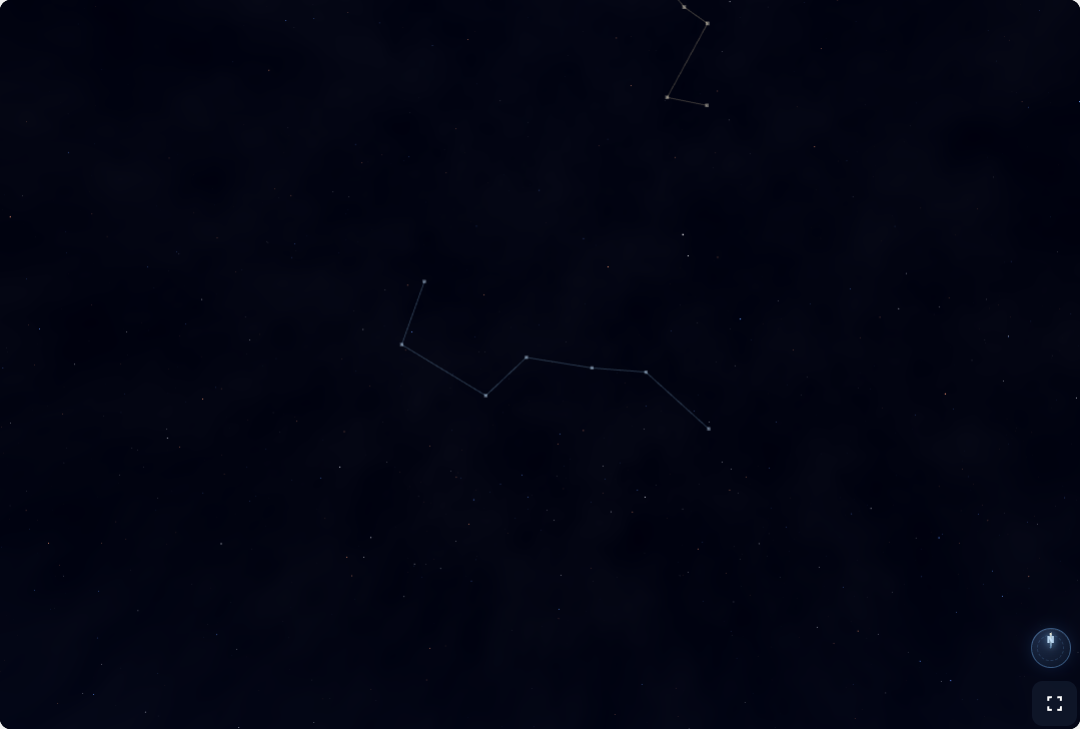
Constellations are regions and stellar patterns recognised across many cultures; modern astronomy recognises 88 official constellations. On charts, stellar positions use right ascension alpha (like longitude on the celestial equator, in hours, minutes, seconds) and declination delta (angle from the celestial equator, like latitude). The simulator lets you explore the sky, brief legends and practical orientation hints (e.g. toward Polaris).
Important: the tropical zodiac used in horoscopes does not match astronomers' constellations; Earth's axis and orbit slowly drift against the stellar background. The simulation shows an astronomical sky map, not astrological forecasts.
Useful formulas (sky, stars, distances)
1. Angular distance between two directions on the sphere
For two points with equatorial coordinates (alpha_1, delta_1) and (alpha_2, delta_2), the angle theta between them satisfies:
2. Apparent magnitude scale (Pogson)
The smaller m numerically, the brighter the object. A difference of one magnitude corresponds to a flux ratio of about 2.512:
3. Parsec from parallax
Parallax p (in arcseconds) measures the apparent shift of a star seen from different points on Earth's orbit. Distance in parsecs:
Kepler's three laws
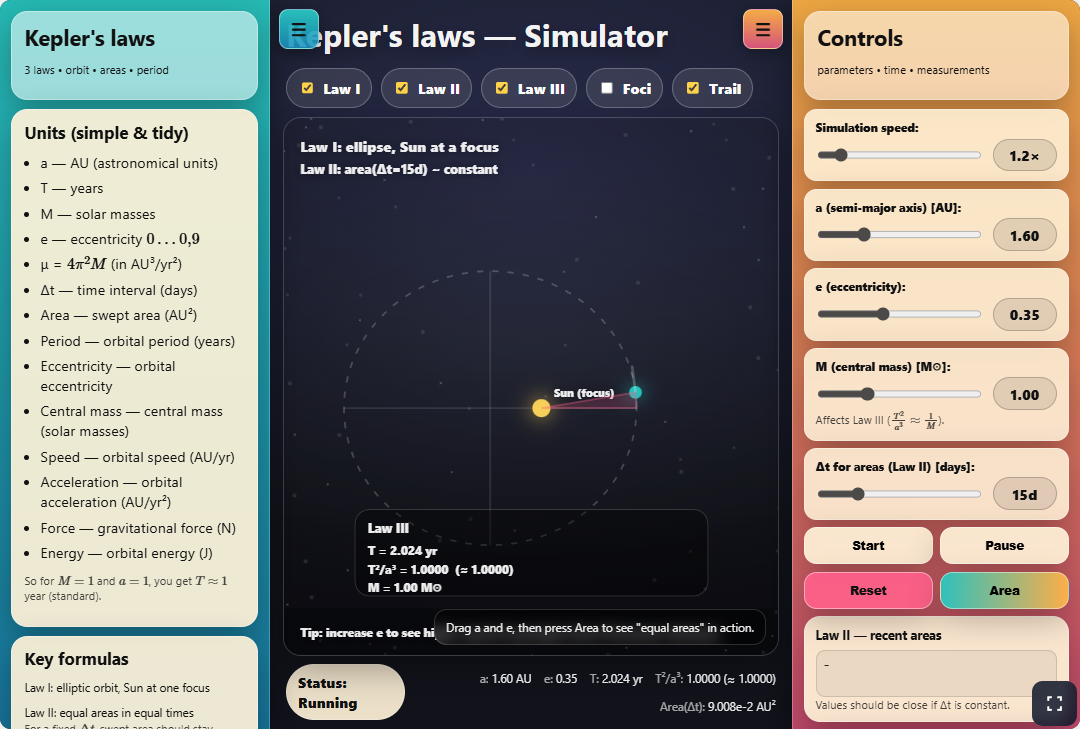
The simulation shows the elliptical orbit, the Sun at a focus, how planetary speed varies, and how orbital period relates to the semi-major axis.
Law I — Orbits are ellipses
Planets move on elliptical orbits with the Sun at one focus. The semi-major axis is a and eccentricity e measures how 'flattened' the ellipse is.
Law II — Law of areas
The radius vector (Sun–planet line) sweeps equal areas in equal times. The planet moves fastest near perihelion and slowest near aphelion.
where L is angular momentum and m is the planet mass.
Law III — Period and semi-major axis
The square of the orbital period is proportional to the cube of the semi-major axis. The ratio T squared / a cubed is the same for all planets orbiting the Sun.
Where: T is period, a semi-major axis, G gravitational constant, M Solar mass.
Planetary motion in a gravitational field
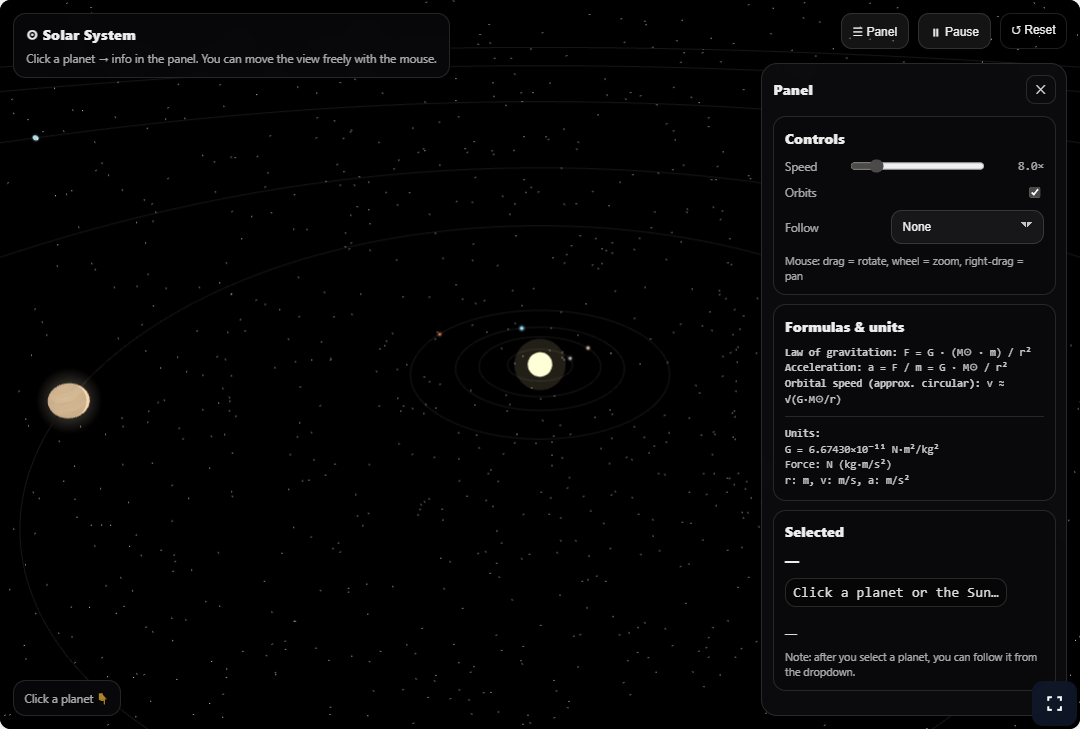
The planetary motion simulator visualises planetary orbits in the solar system and how they arise from attraction toward the central star. For tightly bound orbits, general-relativity corrections explain effects such as Mercury's perihelion precession.
Theory and useful formulas:
1. Universal gravitation (Newton):
Where: M stellar mass, m planet mass, r centre separation, G gravitational constant. This force acts as centripetal and keeps the planet on its orbit.
2. Orbital speed on a circular orbit:
3. Specific mechanical energy on an elliptical orbit:
Where a is the semi-major axis. All bound (elliptical) orbits around the same star have negative energy; tighter orbits correspond to lower (more negative) energy.
4. Relativistic correction (perihelion precession, simplified sketch):
This expression (radians per orbit) shows how much the ellipse's major axis rotates each revolution in general relativity. The effect is tiny for ordinary planets but measurable for Mercury and is a classical test of Einstein's theory.
Michelson–Morley experiment
In the late 19th century light was assumed to propagate through an invisible medium called "luminiferous ether". If so, Earth's motion through the ether ought to produce an "ether wind" changing the apparent speed of light along different directions.
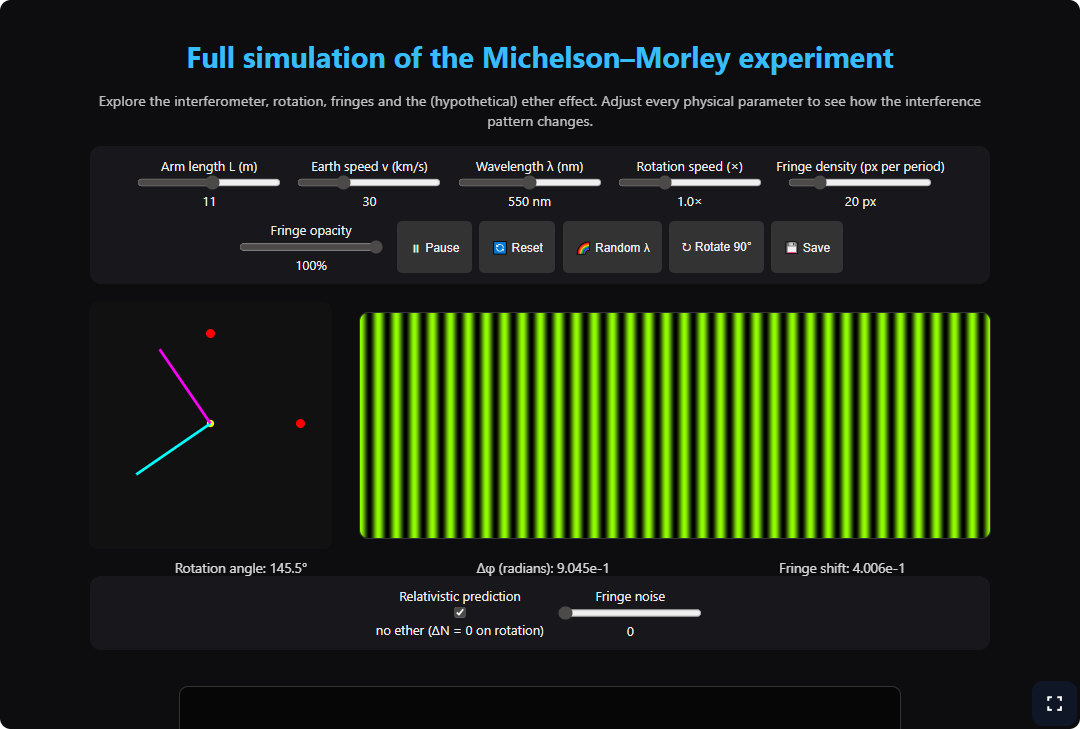
Albert A. Michelson and Edward W. Morley's experiment (1887) compared travel times along two perpendicular paths in an interferometer. The expected asymmetry did not appear: the speed of light seemed the same in all directions — paving the way for special relativity (Einstein, 1905), with implications for astronomical observations relying on interference.
The interferometer splits a beam into two perpendicular arms of length L, reflects from mirrors and recombines the beams. Had an ether wind of speed v existed, travel times would differ slightly; in reality, within experimental precision the difference was zero — no privileged ether.
Useful derived formulas
Quick recap—quantities tied to stars and the sky alongside orbits:
- Angular distance on sphere (RA/Dec):
- Magnitude (Pogson):
- Parsec:
- Mean orbital speed:
- Mechanical energy on elliptical orbit:
- Speed at perihelion (maximum):
- Speed at aphelion (minimum):