Simple harmonic oscillatory motion.
Properties of simple harmonic oscillation.
The harmonic linear oscillator is an idealised physical model that describes periodic motion of an object subjected to a restoring force proportional to its displacement from equilibrium. It is fundamental in mechanics, electromagnetism, acoustics — and appears even in quantum descriptions.
Try our simulations to see how harmonic oscillators behave and to build intuition about period, frequency and amplitude.

Pendulums
The pendulum is a classic oscillator. Studying its motion illustrates period, frequency, and restoring forces.
Use our simulations to compare different pendulum behaviours side by side.
Gravity pendulum (simple pendulum)
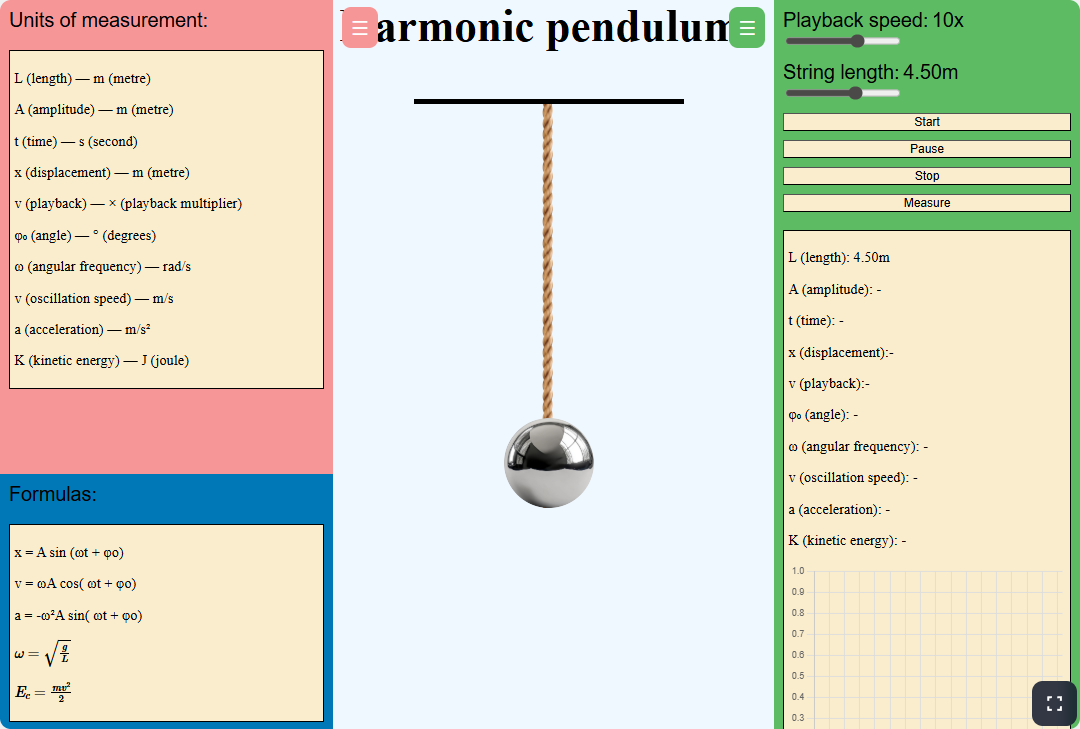
A gravitational pendulum is a point-like mass suspended from a massless inextensible string of length ℓ. If released near equilibrium with a small deviation angle θ, oscillations are approximately simple harmonic motion with period
Damped pendulum
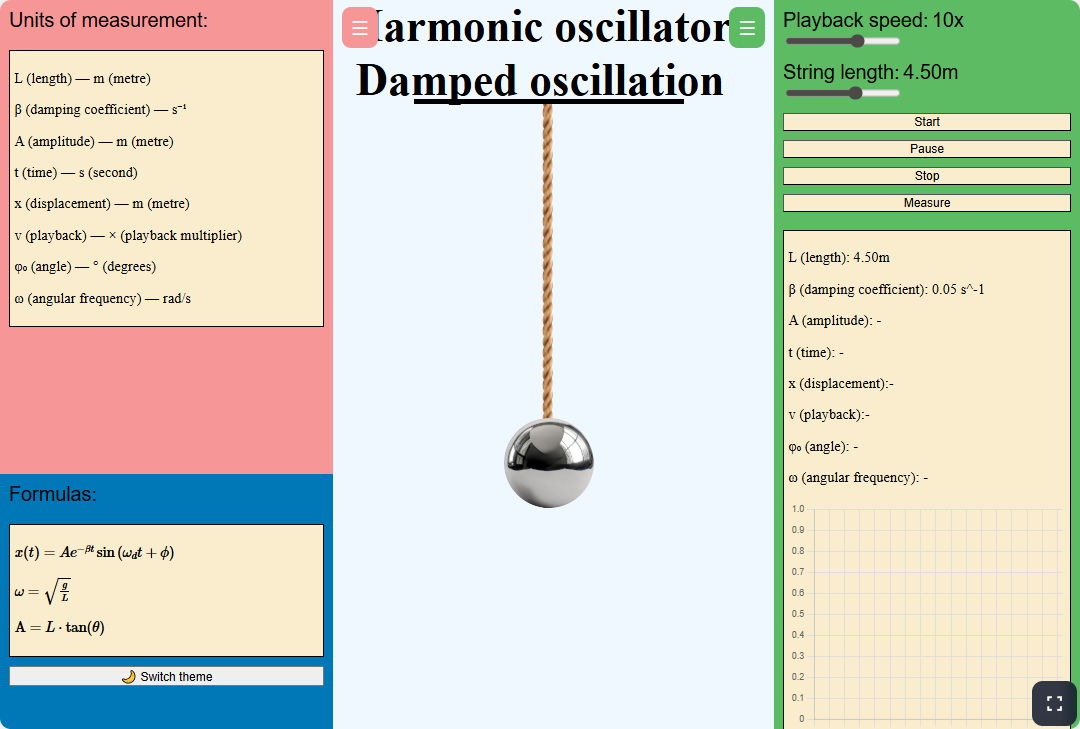
A damped oscillator loses amplitude over time owing to dissipative forces (air resistance, friction, viscosity). Understanding damping is central to modelling real oscillators.
Features
- Oscillations with decreasing amplitude.
- The period depends on the damping coefficient (in detailed models).
- Different behaviour at larger amplitudes.
- Viscous damping often gives a relation between restoring force/drive and velocity that is locally linear.
- Example: pendulum with friction.
- Equation of motion:
Nonlinear simple pendulum
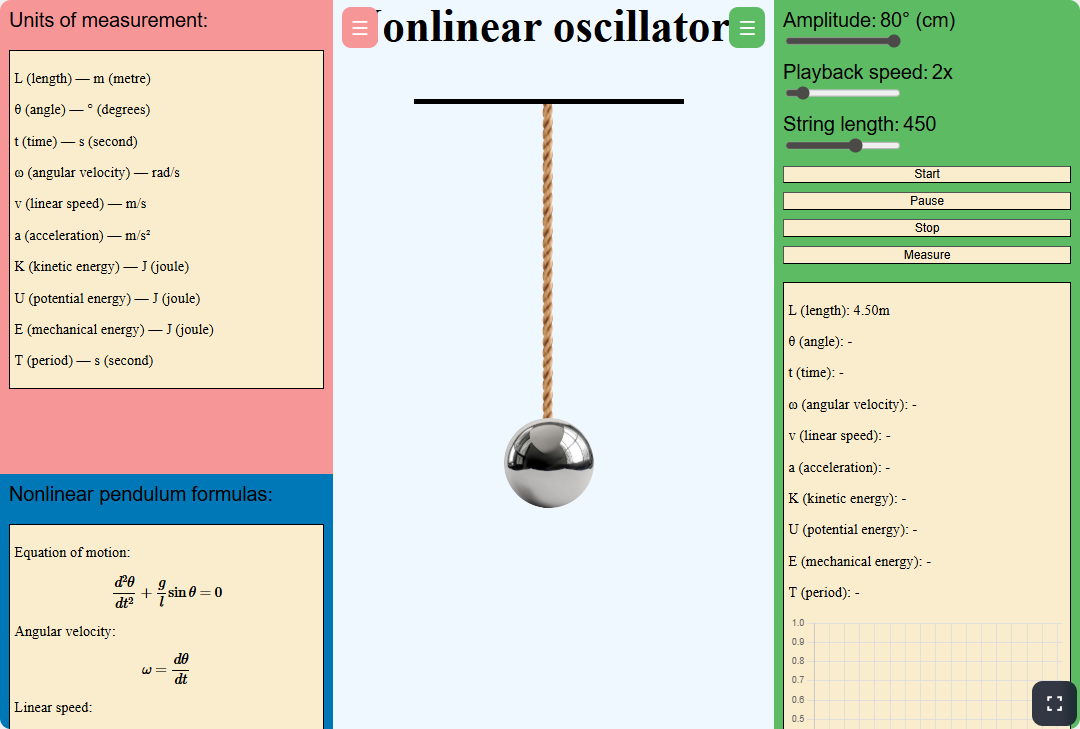
A mass swings on an inextensible string driven by gravity, without restricting the angular displacement to remain small: for larger angles the motion is no longer sinusoidal and the period depends on amplitude.
Multiple pendulums
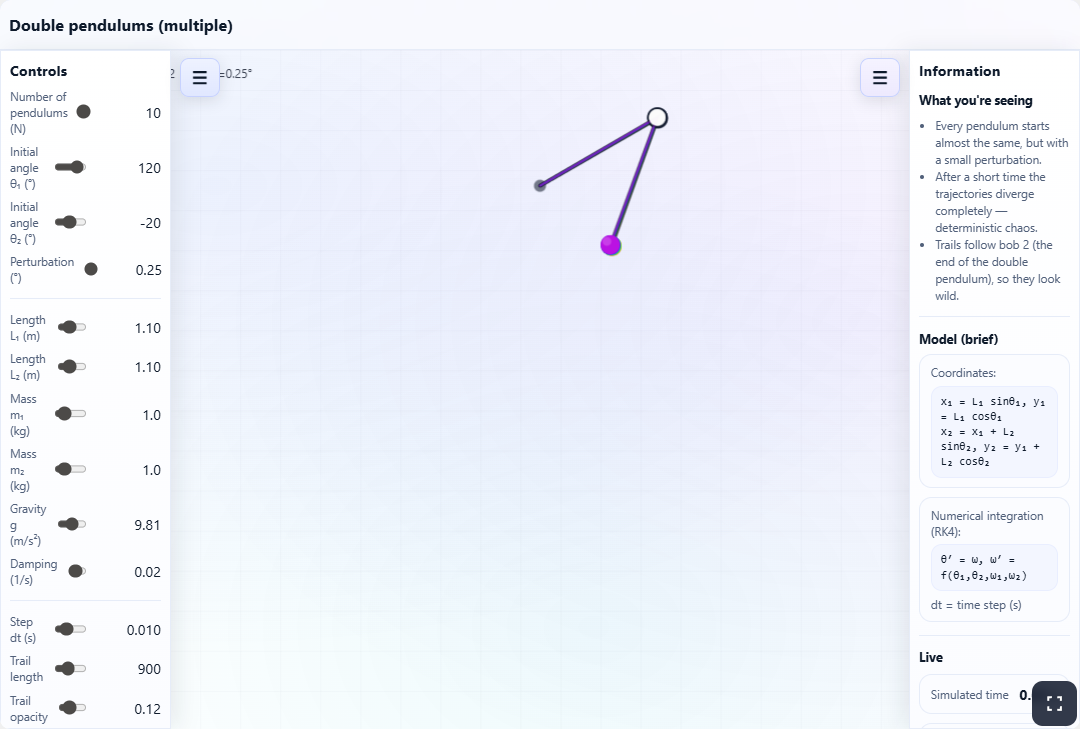
The multiple pendulums sandbox shows how deterministic chaos arises: pendulums that start almost alike quickly follow very different paths — pronounced sensitivity to initial conditions.
What you can explore in the simulator
- How nearly identical pendulums desynchronize because motion is nonlinear.
- Colourful trails exposing intricate, quasi-irregular trajectories.
- Transitions from roughly periodic motion to chaotic behaviour depending on parameter values.
Useful relations
In the ideal frictionless model, each pendulum obeys the same nonlinear pendulum equation with slightly different initial conditions:
For small angles each pendulum is well approximated as harmonic:
Even though the differential equations look simple, coupled or nearly independent setups are extremely sensitive: a tiny change in initial angle or angular velocity leads to completely different long-time behaviour — exactly what the simulation highlights.