Waves
Waves transmit oscillations — mechanical, electromagnetic or other — between points in matter or vacuum.
Characteristics
- Waves belong to principal families:
- A. Mechanical waves
A mechanical wave is a local disturbance spreading through an elastic medium because neighbouring particles interact through elastic restoring forces — hence mechanical waves are also called elastic waves. - B. Electromagnetic waves
Electromagnetic waves arise from perpendicular electric and magnetic fields that regenerate each another and travel together through space. Unlike mechanical waves they need no medium, so electromagnetic waves propagate also in vacuum.
Wave types relative to propagation
- A. Longitudinal waves
In longitudinal waves the particle motions are parallel to the propagation direction: the medium is alternately compressed and rarefied along the propagation path. - B. Transverse waves
In transverse waves the particle motions lie perpendicular to the propagation direction.
Sound tube — fundamental frequency
Shows how longitudinal sound modes build up in pipes and how the fundamental frequency is identified.
Standing waves on a string
Explore standing waves along a taut string — constructive and destructive interference at nodes and loops.
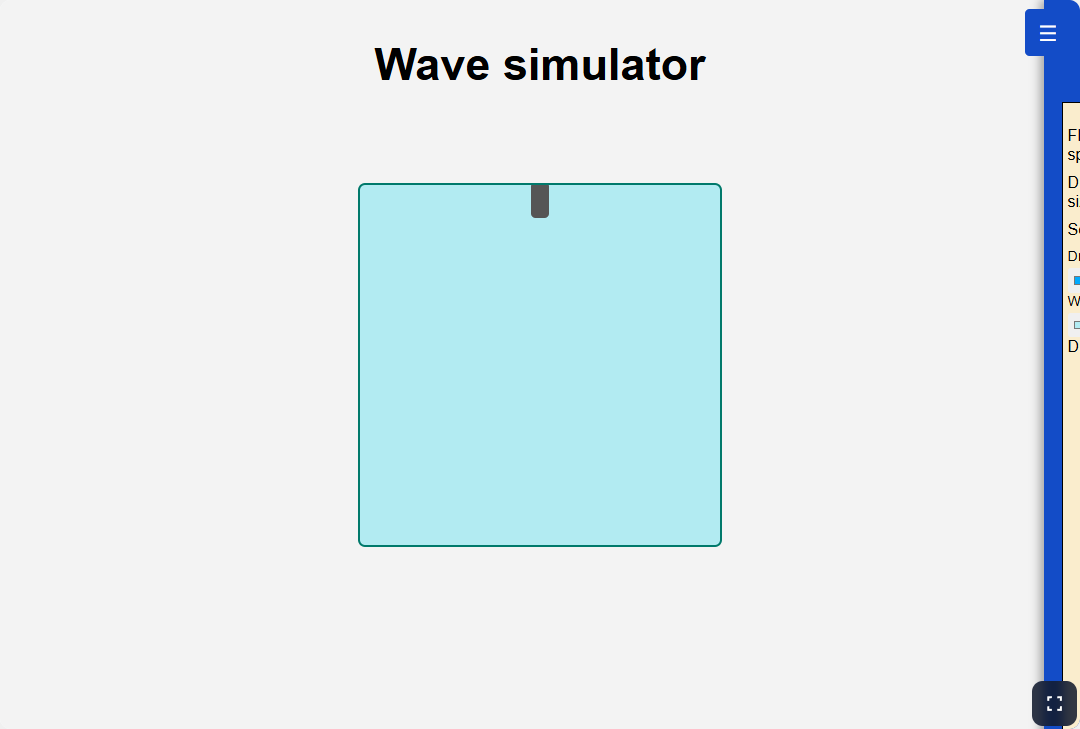
Water surface waves simulator
This simulation visualises ripple-like propagation across the water surface — how disturbances spread through a fluid. Interact with the scene to probe how differing sources and patterns propagate.
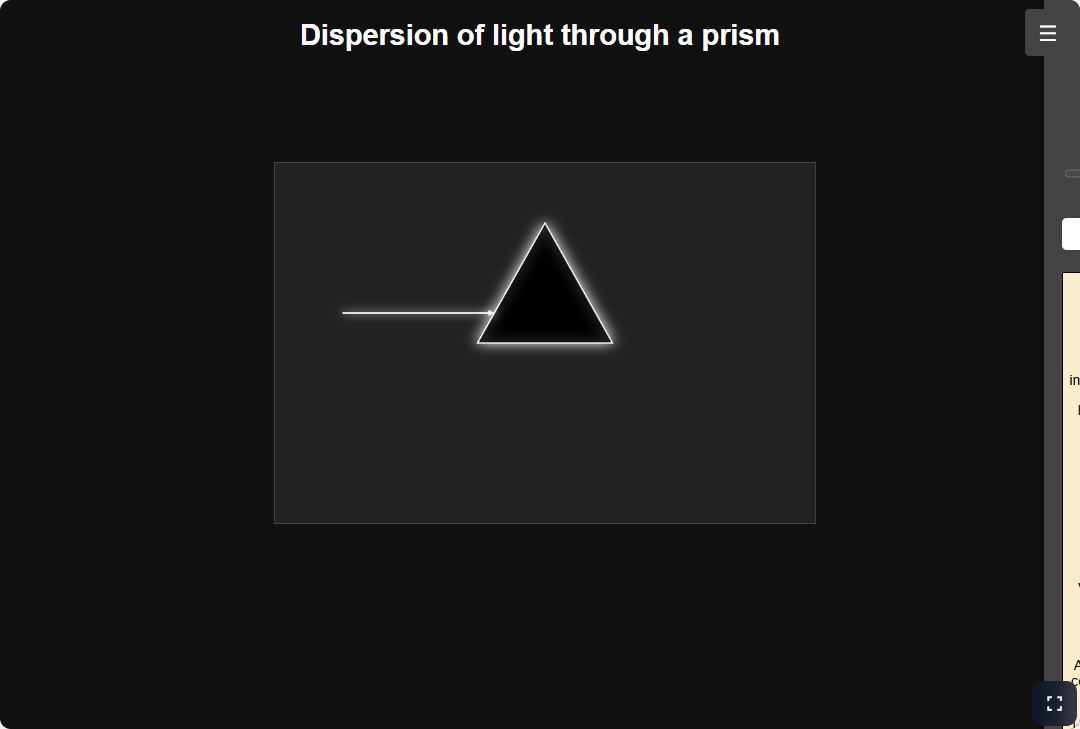
Prism optics
A prism is a transparent body with polished faces (often triangular) that bends light by refraction.
When white light passes through a prism, wavelength-dependent refraction disperses it into spectral colours.
Prisms are staples of undergraduate optics demos for splitting sunlight into reds, oranges, greens, blues, violet, and so forth.
Roughly speaking, white sunlight is built from overlapping wavelength components — as famously explored by Newton centuries ago.
Dispersion of white light through a prism
Observe how dispersion separates white light entering a transparent prism with wavelength-dependent refractive index.
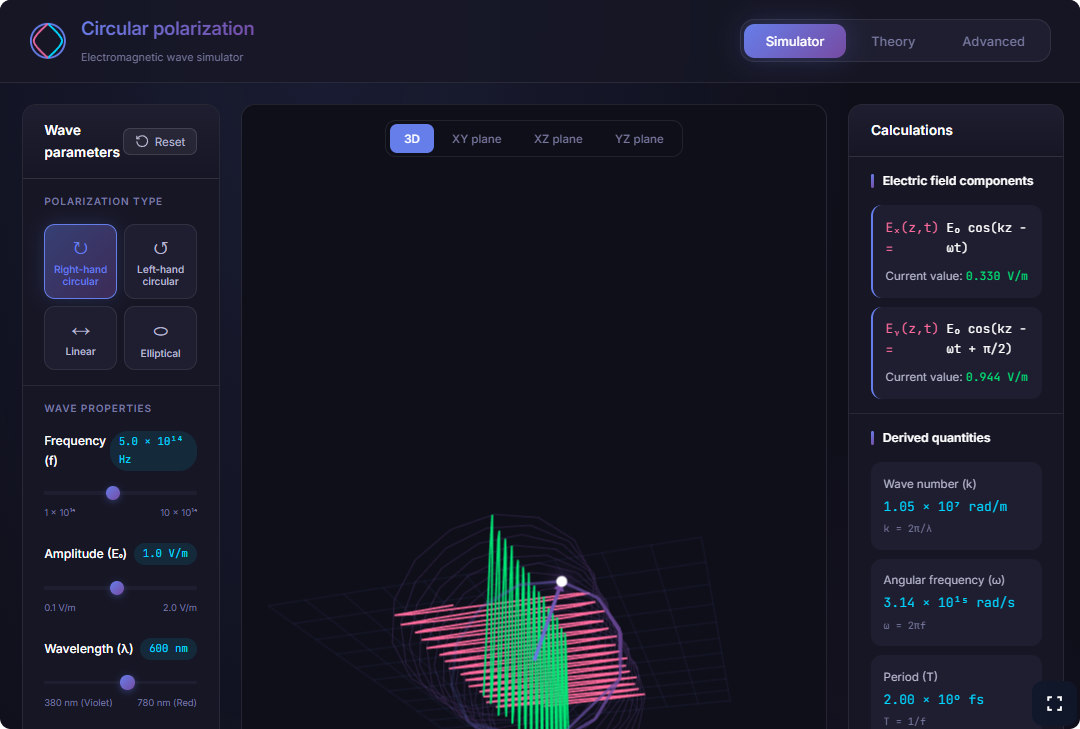
Circular polarisation of electromagnetic waves
Circularly polarised light can be regarded as the superposition of two perpendicular linearly polarised components of equal amplitude with a phase shift of π/2. The endpoint of the electric-field vector then traces a circle in the plane perpendicular to the propagation direction.
Mathematical sketch (right-circular polarisation)
Take electric-field components along orthogonal x and y axes with amplitude E₀ and a relative phase difference of π/2:
At every instant the electric-field vector
The tip of