Thermodynamics
Thermodynamics is the branch of physics that studies energy transformations and the laws governing them. It describes macroscopic systems using thermodynamic variables such as temperature, pressure, volume and internal energy.
Core ideas include internal energy, entropy, heat, work and thermodynamic potentials. They are linked by the fundamental laws that govern physical and chemical processes.
Thermodynamics is essential for heat engines, refrigeration, chemical processes and many natural and technological phenomena involving energy transfer and conversion.
Fundamental thermodynamic processes
Thermodynamics studies energy transformations and the laws governing them. Key concepts are temperature, pressure, volume, internal energy and entropy.
A thermodynamic system is described by state variables such as pressure (p), volume (V), temperature (T) and particle number (N). They are related by equations of state that describe each substance.
Processes may be reversible or irreversible, isothermal, isobaric, isochoric or adiabatic — each with specific equations reflecting energy conservation and entropy increase.
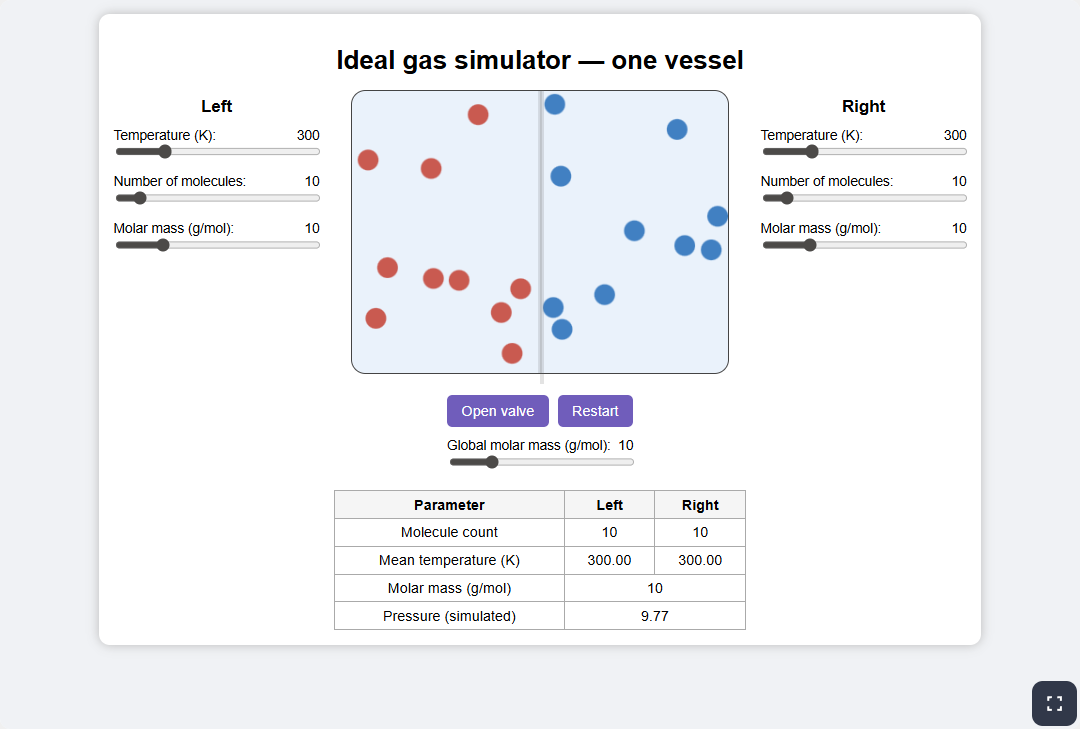
Essential thermodynamics formulas:
1. First law of thermodynamics:
2. Ideal gas equation of state:
3. Entropy (Boltzmann definition):
4. Second law of thermodynamics:
5. Internal energy of an ideal gas:
6. Work in reversible processes:
7. Heat capacity at constant volume:
8. Heat capacity at constant pressure:
9. Enthalpy:
10. Helmholtz free energy:
11. Gibbs free energy:
12. Isothermal compressibility:
13. Thermal expansion coefficient:
14. Carnot engine efficiency:
where: U internal energy, Q heat, L work, p pressure, V volume, n moles, R gas constant, T temperature, S entropy, k_B Boltzmann constant, Ω number of microstates, f degrees of freedom, H enthalpy, F Helmholtz free energy, G Gibbs free energy, κ isothermal compressibility, α thermal expansion coefficient, η efficiency, T_C cold reservoir temperature, T_H hot reservoir temperature.
Heat engines
Heat engines convert thermal energy (heat) from a hot reservoir into useful mechanical work, rejecting part of the energy to a cold reservoir. Examples include internal combustion engines (Otto, Diesel), gas and steam turbines, and the idealised Carnot engine.
The heat-engine simulator lets you visualise thermodynamic cycles on p–V and T–s diagrams, compare efficiencies and understand each phase: compression, heating/combustion, expansion and exhaust.
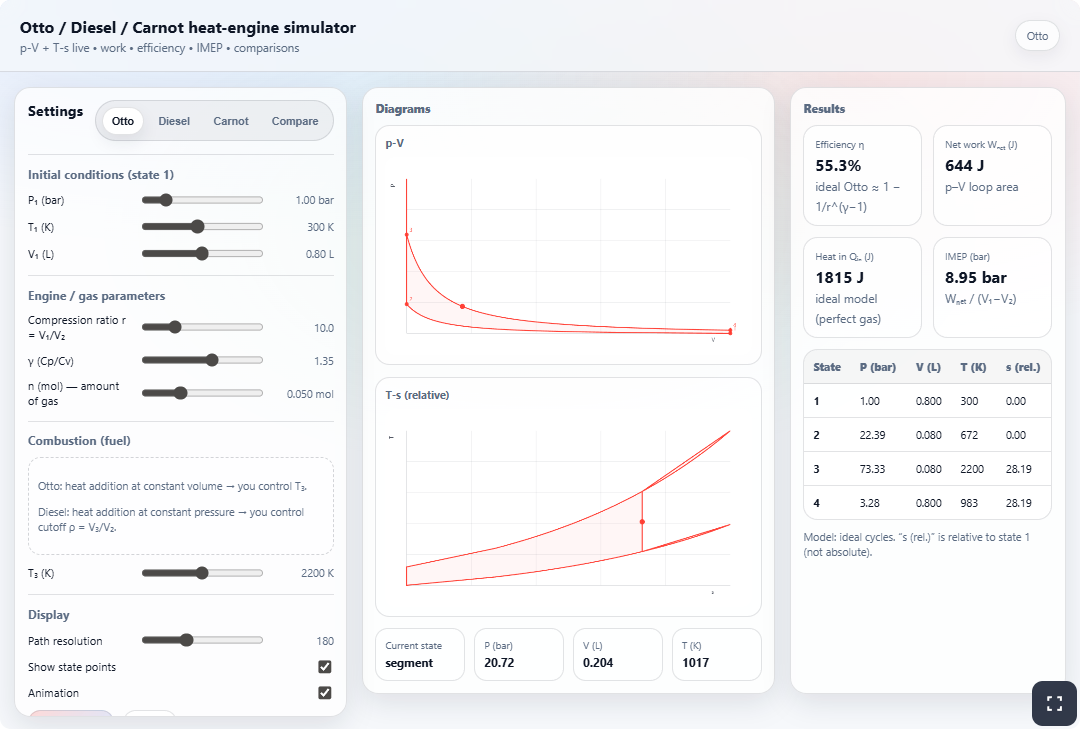
Key heat-engine formulas:
1. Thermal engine efficiency:
2. Ideal (Carnot) efficiency:
3. Work in a thermodynamic cycle:
4. Heat exchanged in an isobaric process:
where: η is efficiency, L_{util} useful mechanical work per cycle, Q_H heat absorbed from the hot reservoir, Q_C heat rejected to the cold reservoir, T_H and T_C absolute temperatures of the hot and cold reservoirs; the contour integral
Internal combustion engines
Internal combustion engines convert the energy released when fuel burns into mechanical work through piston motion. The best-known types are four-stroke engines (Otto petrol and Diesel) and two-stroke engines.
The animated simulator shows the four phases — intake, compression, power/expansion and exhaust — on a 4-stroke engine, compares petrol, diesel and 2-stroke cycles, and links piston motion to the p–V diagram: the enclosed area is the mechanical work produced in one complete cycle.
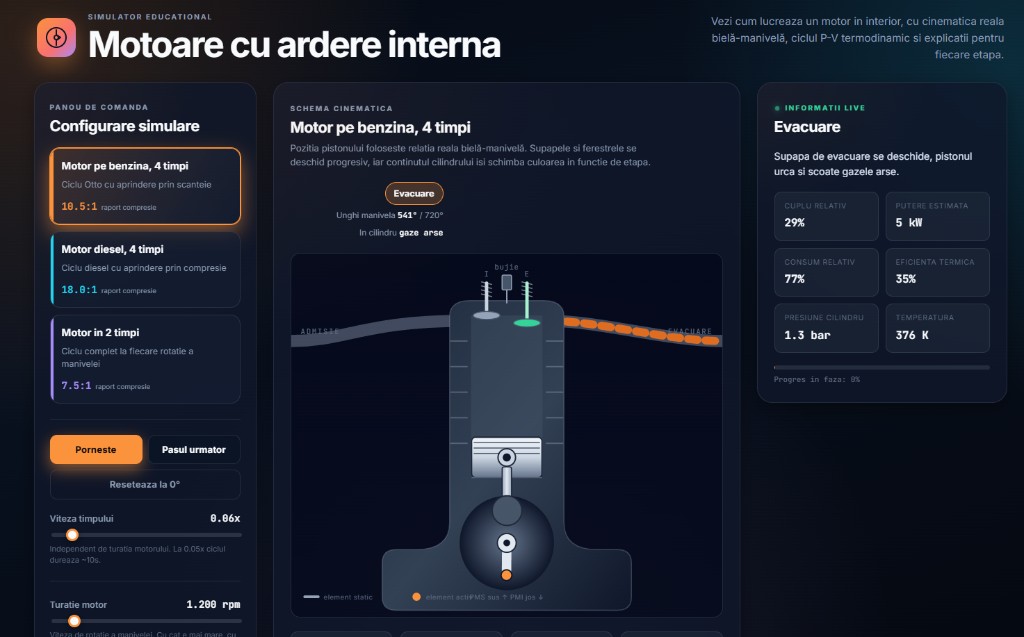
Useful formulas for internal combustion engines:
1. Displacement volume of one cylinder:
2. Adiabatic compression (approximation):
3. Thermal efficiency of the engine:
4. Mechanical work on the p–V diagram:
where: V is the displacement volume of one cylinder, d the bore (diameter), s the piston stroke, γ the adiabatic exponent (~1.4 for air), η thermal efficiency, L_{util} useful work per cycle, Q_{combustion} heat released during combustion; the contour integral
Periodic table (useful quantities for problems)
The periodic table gives element symbols, atomic number Z and — especially — molar mass M for mole, particle and concentration calculations. These quantities appear often in gases, mixtures, calorimetry and the ideal gas law.
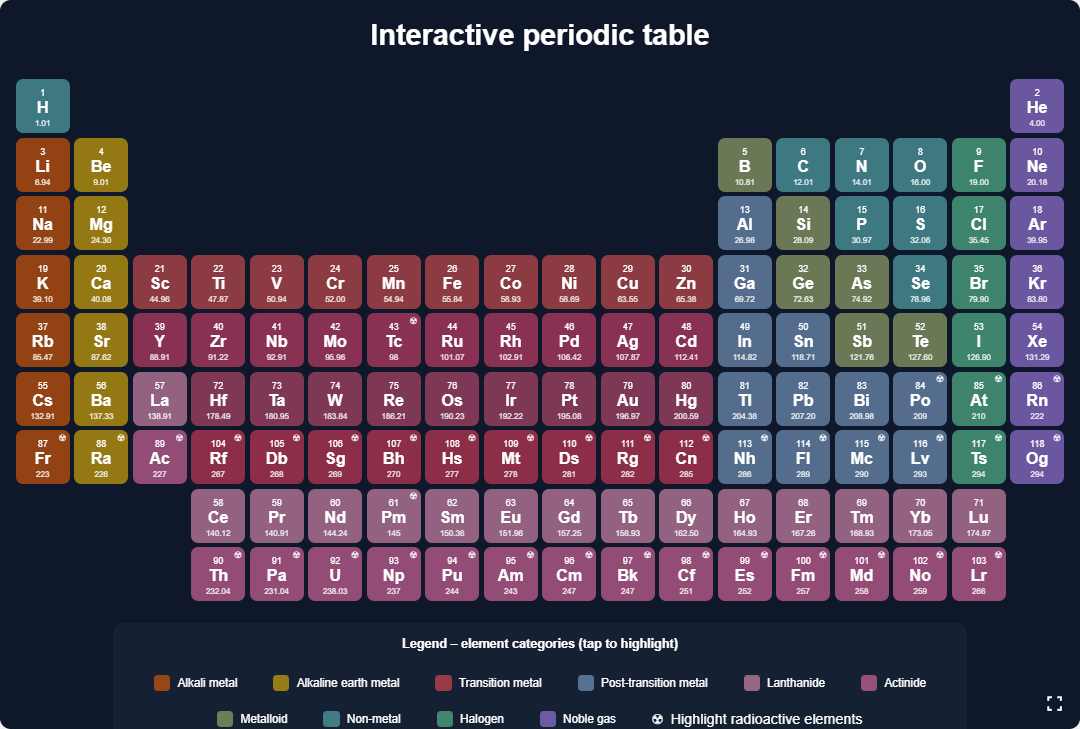
Useful relations:
1. Atomic number Z equals number of protons:
2. Mass number A:
3. Number of neutrons N:
4. Amount of substance (moles):
5. Mass from amount of substance:
6. Number of particles:
7. Avogadro constant:
8. Molar concentration:
where: Z proton count, A mass number, N neutron count, n amount of substance (moles), m mass, M molar mass, N_A Avogadro constant, c molar concentration, V volume.