Optics
Optics studies light: its behaviour and properties and its interaction with matter. It spans geometrical optics, physical optics and quantum optics.
Topics include reflection, refraction, interference, diffraction and polarisation — essential for optical systems from simple lenses to complex instruments.
Applications range from lighting and medical imaging to lasers and optical fibre.
Thin lenses
Thin lenses refract light to form images. They may be converging (convex) or diverging (concave), each with characteristic image formation.
Thin-lens equations relate object and image distances and sizes — the basis of many optical systems.
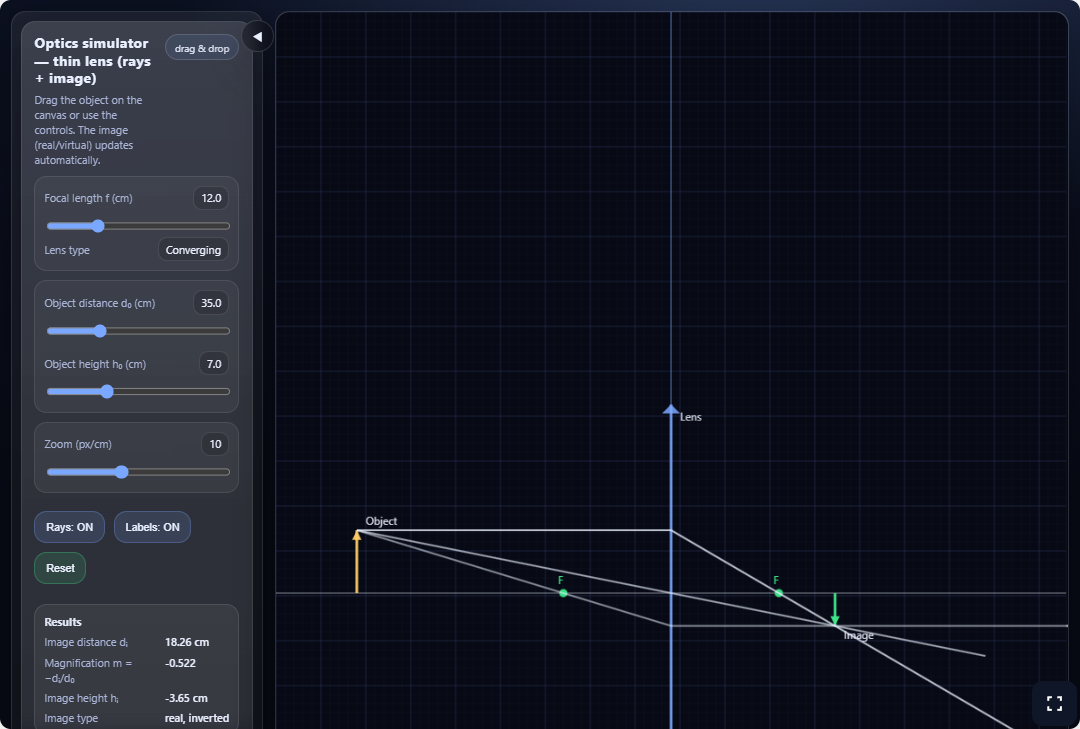
Thin-lens formulas:
1. Thin lens equation:
2. Linear magnification:
3. Optical power (convergence):
4. Lensmaker's formula:
5. Optical power of a lens system:
6. Angular magnification:
where: f focal length, x₁ object distance, x₂ image distance, β linear magnification, y₁ object height, y₂ image height, C optical power (convergence), n refractive index, R₁ and R₂ radii of curvature, γ angular magnification, α₁ and α₂ angles.
Refraction and reflection
Refraction and reflection describe light at interfaces between media with different refractive indices. They follow the laws of reflection and refraction.
Snell's law relates incidence and refraction angles to the indices. Total internal reflection occurs when light goes from a higher to a lower index. Many effects — desert mirages or objects appearing bent in water — come from how the index varies.
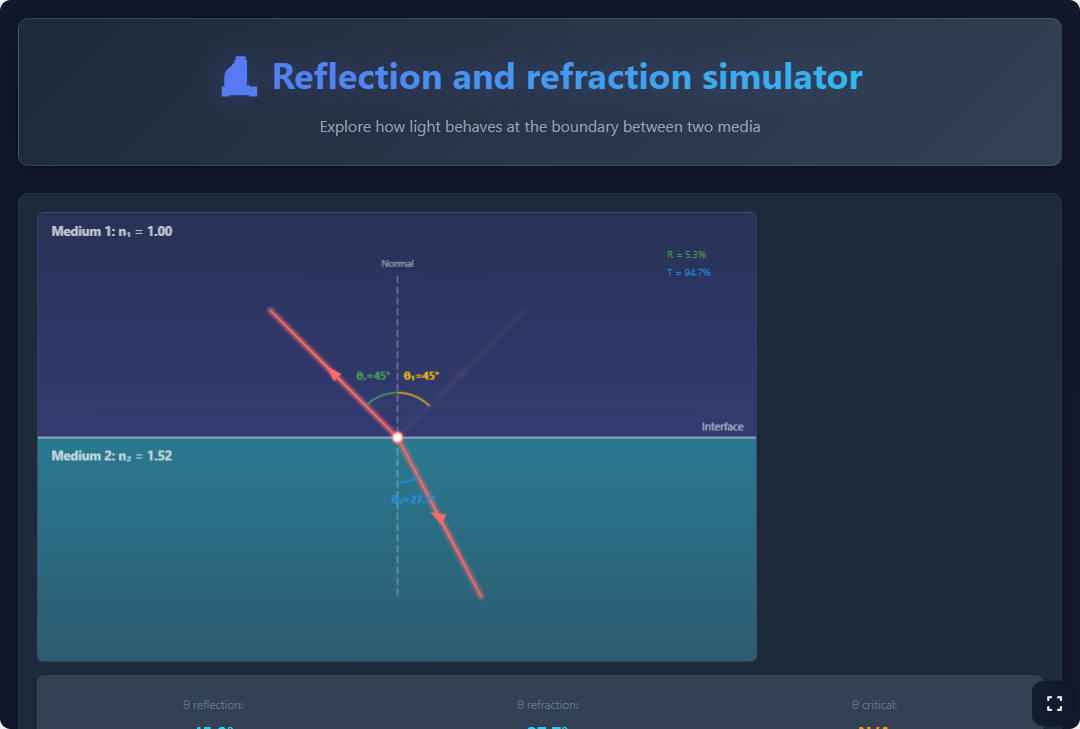
Refraction and reflection formulas:
1. Refractive index:
2. Snell's law (refraction):
3. Law of reflection:
4. Critical angle for total internal reflection:
5. Speed of light in a medium:
6. Wavelength in a medium:
where: n refractive index, c speed of light in vacuum, v speed in medium, i and r incidence and refraction angles, θ₁ and θ₂ angles in the two media, θᵢ and θᵣ incidence and reflection angles, θcrit critical angle, λ₀ wavelength in vacuum, λₙ wavelength in medium.
Prism and dispersion of light
A prism refracts light and splits it into spectral components. Dispersion occurs because the refractive index depends on wavelength.
Dispersion explains rainbows and underpins many optical instruments. Studying prisms clarifies light behaviour in dispersive media.
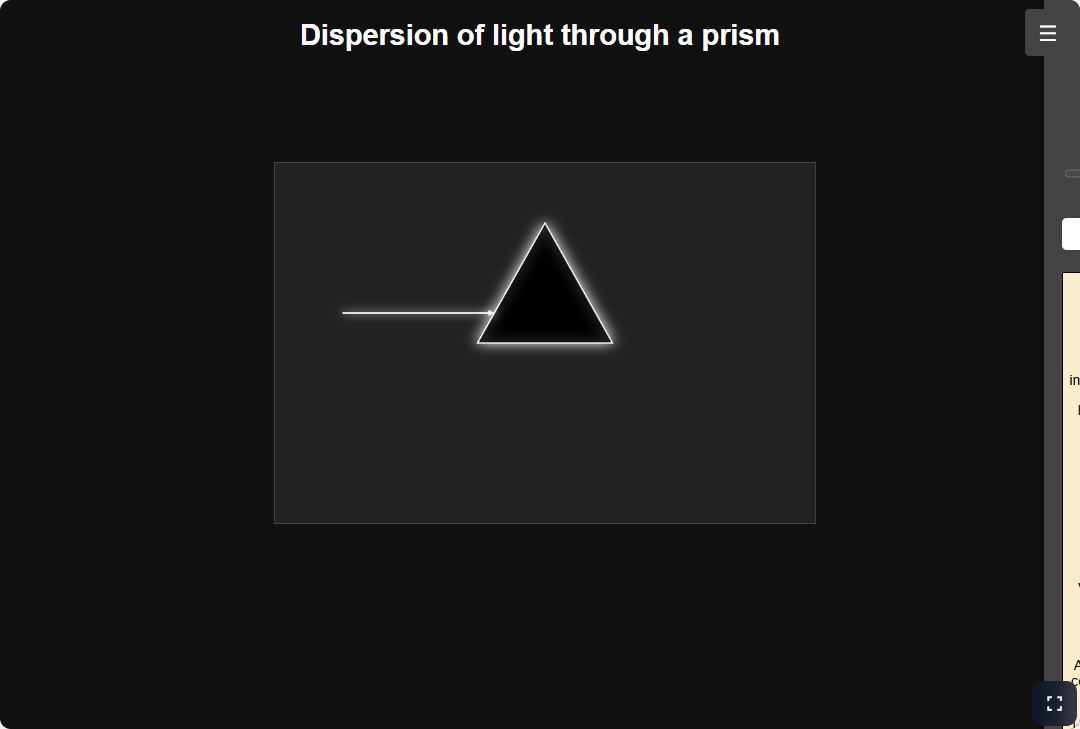
Prism and dispersion formulas:
1. Angle of deviation:
2. Angular dispersion:
3. Dispersive power:
4. Cauchy formula for refractive index:
where: δ deviation angle, A apex angle of the prism, i₁ and i₂ incidence and emergence angles, D angular dispersion with respect to λ, P dispersive power, n_F, n_C, n_D refractive indices at standard spectral lines, A,B,C Cauchy coefficients (not the apex).
Atmospheric refraction
Atmospheric refraction bends light through layers of different density. It causes mirages and lets the Sun appear above the horizon when it is already geometrically below it.
It matters for astronomy, navigation and meteorology and shows how atmospheric optical properties affect observations.
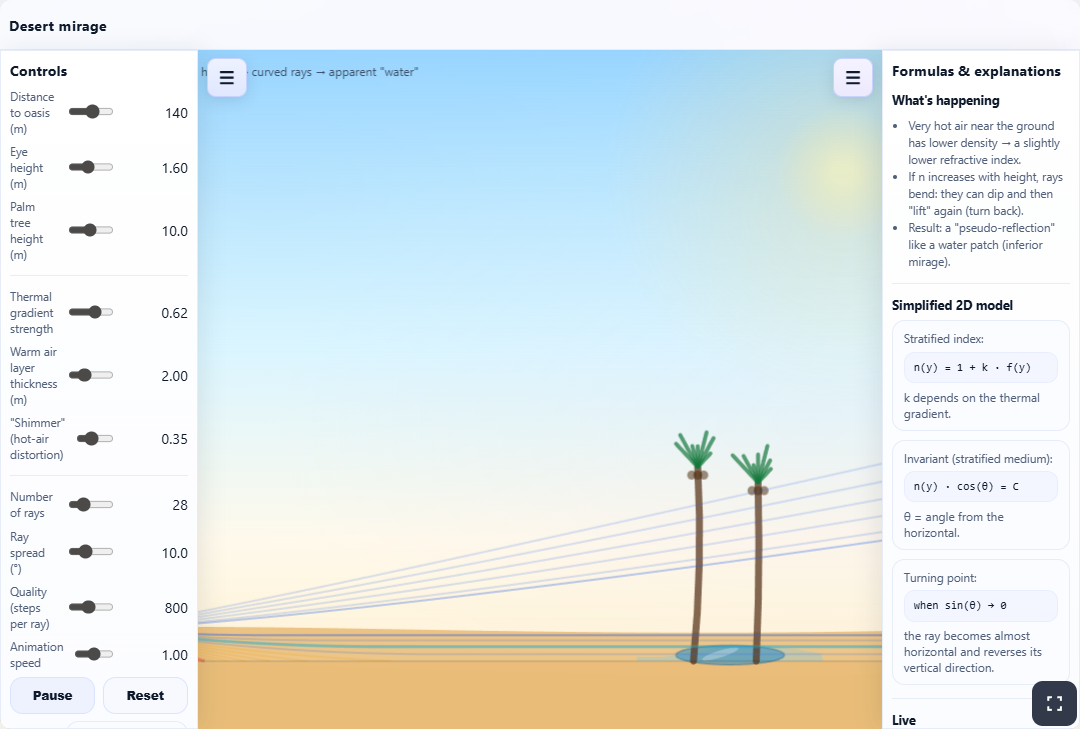
Atmospheric refraction and mirage formulas:
1. Refractive index of air:
2. Angle of atmospheric refraction:
3. Low-altitude refraction correction:
where: n_air air refractive index, T temperature (K), p pressure (hPa), e water vapour pressure, θᵢ incidence angle, θᵣ refraction angle, Δθ refraction correction, z zenith distance.
Laser
A laser produces a coherent, nearly monochromatic beam with low divergence. In applications (telecom, medicine, metrology), wavelength, frequency, energy and intensity are linked.
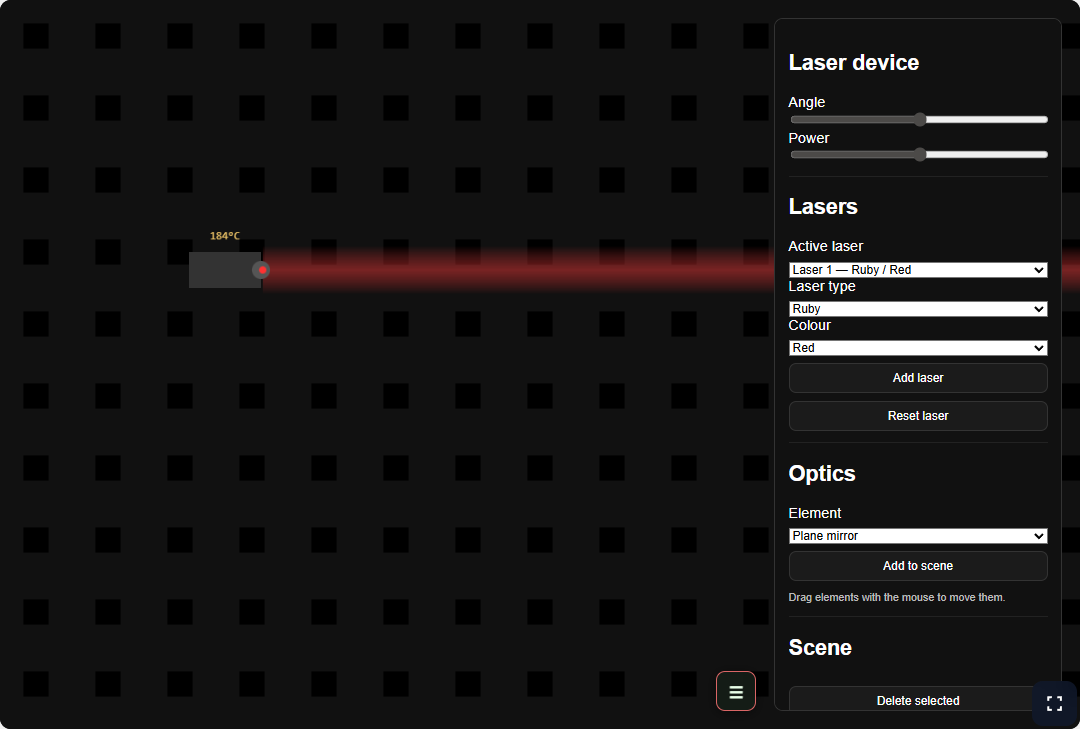
Essential laser formulas:
1. Wave–frequency relation:
2. Photon energy:
3. Photon momentum:
4. Intensity (power per area):
5. Inverse-square law (point source):
6. Minimum divergence (Gaussian beam):
7. Rayleigh range:
where: c speed of light, λ wavelength, f frequency, h Planck constant, E energy, p momentum, P power, A area, r distance, θ divergence, w₀ beam waist radius, z_R Rayleigh range.
Electromagnetic spectrum
Electromagnetic waves are described by frequency and wavelength; photon energy increases with frequency. The spectrum spans radio through gamma rays.
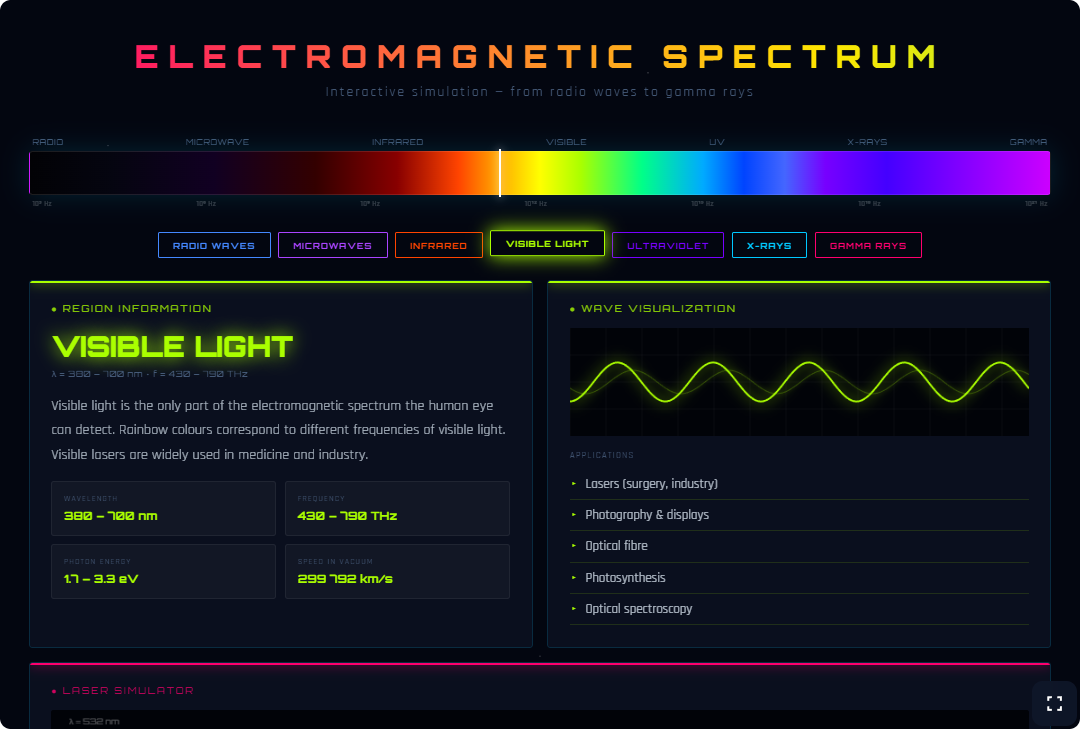
Essential formulas:
1. Wave–frequency relation:
2. Photon energy:
3. Photon momentum:
4. Intensity (plane wave):
5. Inverse-square law (spherical propagation):
6. Wien's displacement law:
7. Stefan–Boltzmann radiated power:
where: c speed of light, λ wavelength, f frequency, h Planck constant, E photon energy, p momentum, P power, A area, r distance, λ_max Wien peak wavelength, T absolute temperature, b Wien constant, σ Stefan–Boltzmann constant, ε emissivity.