Earthquakes
An earthquake is a sudden release of energy inside Earth that generates seismic waves.
Earthquakes are caused by rapid stress release in the crust, producing seismic waves that propagate through the planet.
These waves can be recorded by seismographs and are used to study Earth's interior structure.
Our simulations provide a visual picture of how seismic waves propagate and interact with different materials.
Earthquake simulation
Animation of seismic waves radiated during an earthquake.
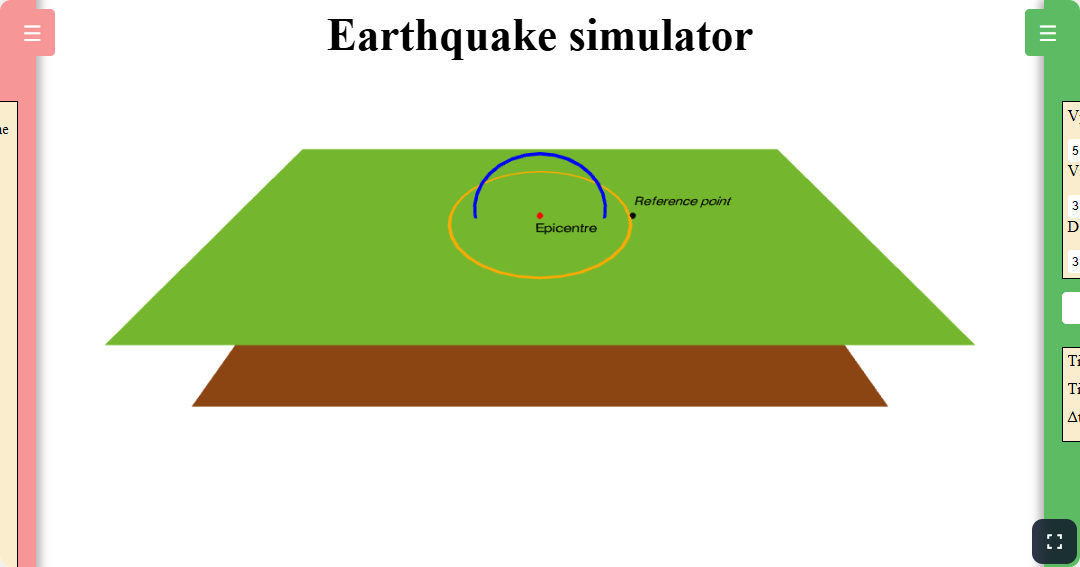
Key points:
- Seismic waves propagate through Earth's interior.
- There are several wave types (P, S, Love, Rayleigh, and more).
- Seismographs record ground motion from these waves.
- P-waves are longitudinal (compressional); S-waves are transverse (shear).
- Surface waves (e.g. Love and Rayleigh) often cause the strongest shaking and damage at the surface.
- P-waves travel faster than S-waves in the same material.
- S-waves do not propagate through the outer liquid core; P-waves do.
P-wave speed from travel time:
S-wave speed from travel time:
where d is the distance from the epicentre to the station, and t is the travel time for each wave type.
Speeds in an elastic medium:
where K is the bulk modulus, G the shear modulus, and ρ the density.
Richter magnitude:
A is the maximum recorded amplitude and A₀ a reference amplitude.
Earthquake experience as a mini-game
☆Use the left and right arrow keys to move around the 3D scene.
☆Press Enter to jump to the next event.