The atom
Atomic structure and how elements are organised in chemistry and physics: from the simplest atom (hydrogen) to the periodic table. Below is essential theory and links to interactive simulations.
Hydrogen atom
The hydrogen atom is the simplest: one proton and one electron. It was an ideal “laboratory” for developing quantum mechanics because its emission spectrum has very clear, sharp lines.
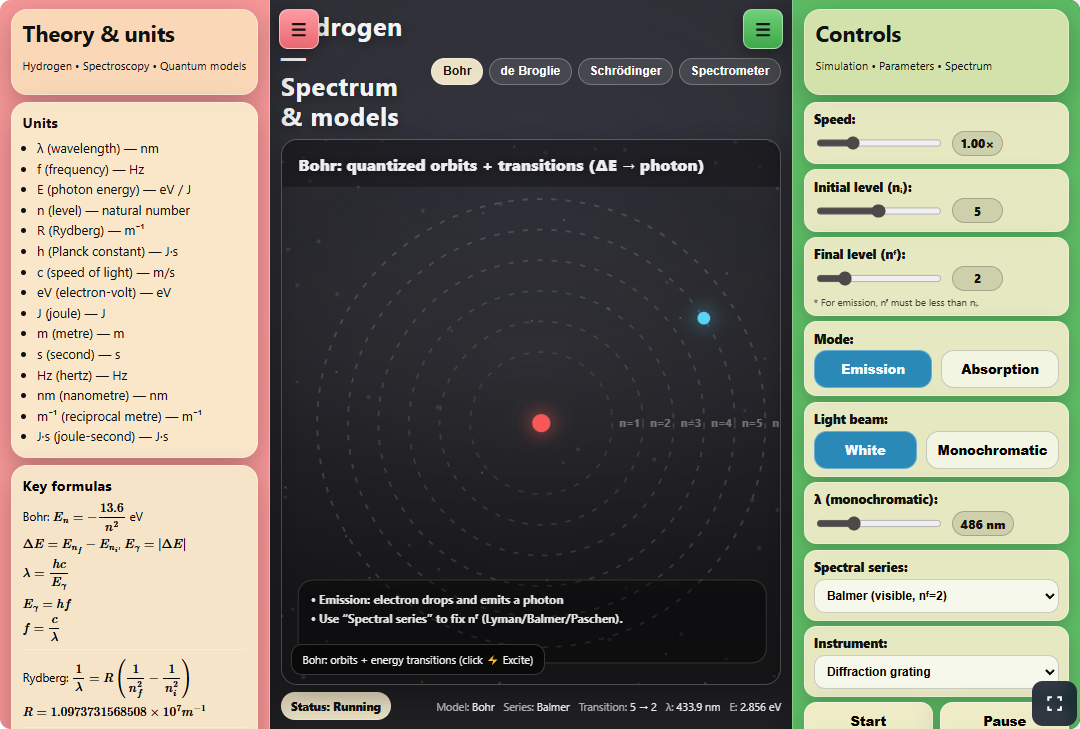
Bohr model — quantised energy levels
Niels Bohr (1913) proposed that the electron cannot have arbitrary energy, only discrete values (energy levels). For hydrogen, the energy of quantum level n = 1, 2, 3, … is:
The value 13.6 eV is the ionisation energy of hydrogen (energy needed to remove the electron from the ground level n = 1 to infinity). The minus sign shows the electron is bound to the proton.
Transitions and spectral lines
When the electron jumps from a higher level E_m to a lower one E_n, the energy difference is emitted as a photon:
The wavelengths of hydrogen spectral lines follow the Rydberg formula:
where R_H is the Rydberg constant for hydrogen; spectral series (Lyman, Balmer, Paschen, …) correspond to different values of n.
Quantum description: the electron wavefunction
In modern quantum mechanics, the electron in hydrogen is described by a wavefunction ψ_{nℓm}(r,θ,φ) that satisfies the Schrödinger equation in the Coulomb potential of the proton:
The solutions yield the same energy levels E_n as Bohr's model, but also orbital shapes (s, p, d, …) and probabilities for finding the electron around the nucleus.
The periodic table of elements
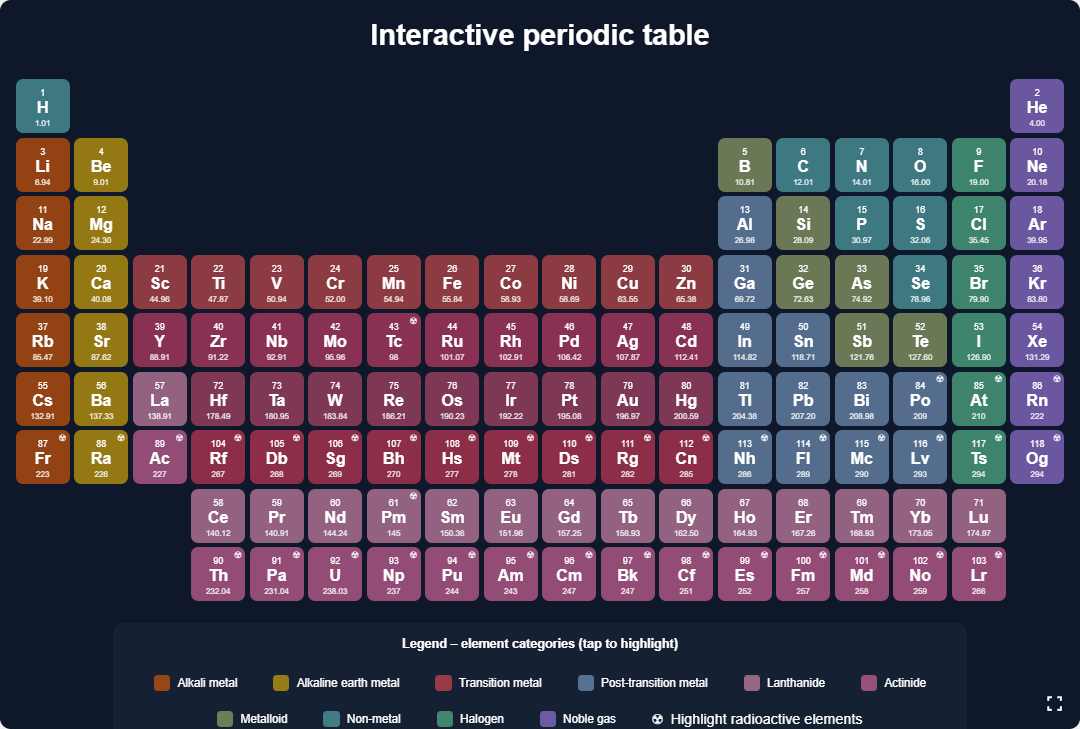
Elements are arranged by atomic number Z. Within a group, atoms have similar outer-shell configurations; across a period, both protons in the nucleus and electrons in shells increase.
Useful formulas / relations (as in the thermodynamics lesson)
1. Atomic number Z equals number of protons:
2. Mass number A:
3. Number of neutrons N:
4. Amount of substance (moles):
5. Mass from amount of substance:
6. Number of particles:
7. Avogadro constant:
8. Molar concentration:
where: Z proton number, A mass number, N neutron number, n amount of substance (moles), m mass, M molar mass, N_A Avogadro constant, c molar concentration, V volume.