Electricity
Electricity is the branch of physics that studies electric charge, currents, electric and magnetic fields and their interactions. It underpins modern technology.
It includes circuit analysis, Ohm's and Kirchhoff's laws, electrical energy and power, and behaviour of resistors, capacitors and inductors.
Understanding electricity is essential for designing and analysing systems from simple circuits to large power networks.
Electric circuits
Circuits are closed paths for current. Analysis rests on Ohm's law and Kirchhoff's rules.
A circuit may contain resistors, voltage sources, capacitors, inductors — each affecting overall behaviour.

Essential circuit formulas:
1. Ohm's law:
2. Electrical power:
3. Electrical energy:
4. Equivalent resistance in series:
5. Equivalent resistance in parallel:
6. Kirchhoff's first law (current law):
7. Kirchhoff's second law (voltage law):
8. Resistance of a conductor:
9. Electric current:
10. Current density:
where: U voltage, I current, R resistance, P power, W energy, q charge, t time, ρ resistivity, l conductor length, S cross-sectional area, n charge carrier density, v drift speed.
Kirchhoff's laws
For multi-node, multi-loop circuits Ohm's law alone is not enough. Kirchhoff's current law (KCL) expresses charge conservation at each node; Kirchhoff's voltage law (KVL) expresses energy conservation around each closed loop.
The simulator below lets you build and analyse such circuits interactively.

Essential formulas (KCL and KVL):
1. First law (KCL) at a node:
2. KCL — current balance:
3. Second law (KVL) on a closed loop:
4. KVL — voltages on resistors and sources:
5. Voltage between two nodes:
where: currents are signed following a chosen convention at each node; voltages are traversed consistently around each loop; R and I are branch resistances and currents; E are source emfs; V are nodal potentials.
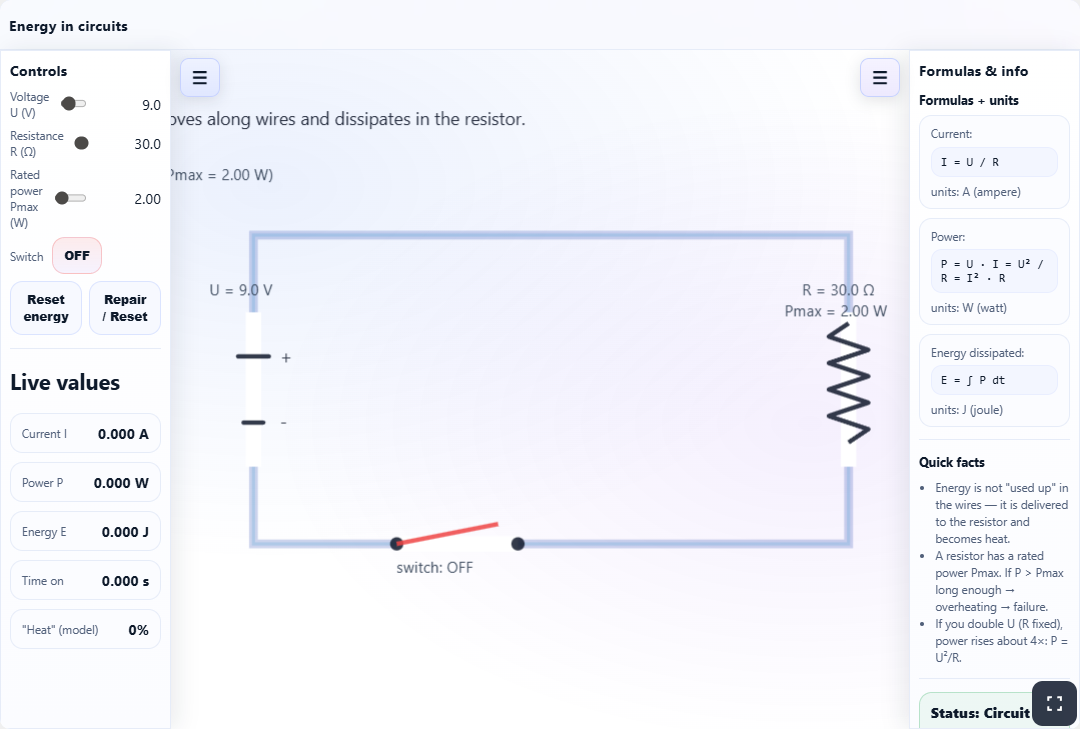
Energy in circuits
Electrical energy is associated with charge motion in a circuit. It can be converted to heat, light, mechanical work, etc.
Energy balance is crucial for efficiency and consumption. Energy supplied by sources equals energy absorbed by components (conservation).
Alternating current (AC)
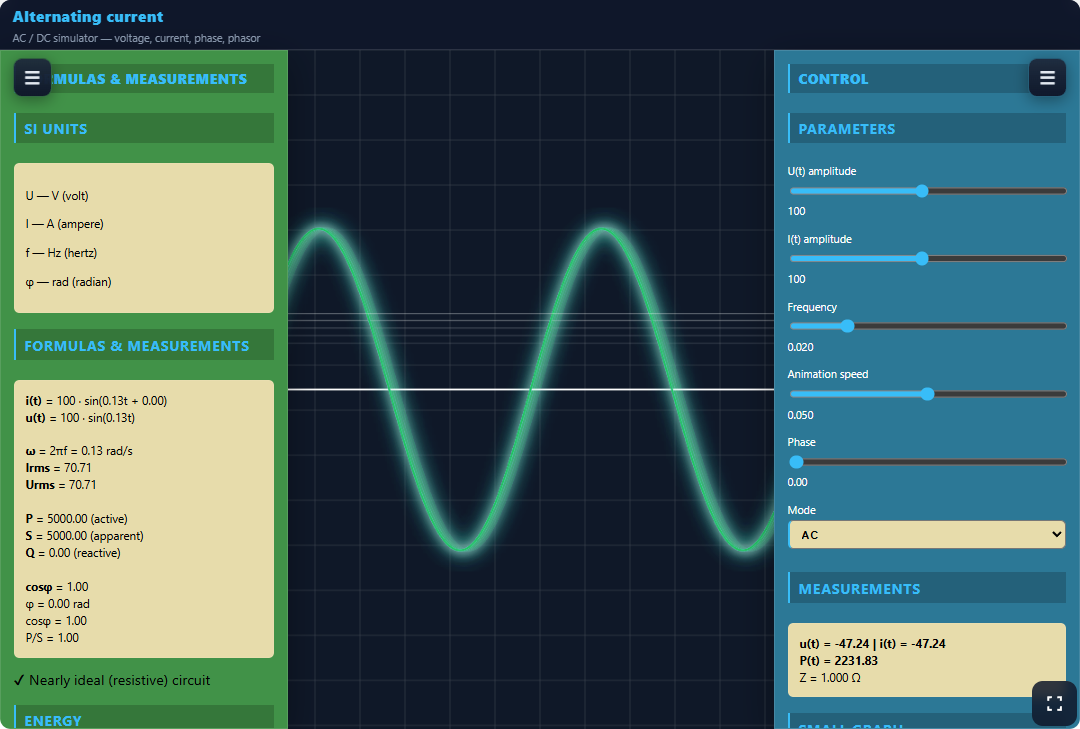
In AC, voltage and current vary in time (usually sinusoidally). In practice we use effective (RMS) values that give the same heating effect as DC.
Essential formulas:
1. Sinusoidal voltage:
2. Sinusoidal current (phase φ):
3. Angular frequency relation:
4. RMS voltage:
5. RMS current:
6. Inductive reactance:
7. Capacitive reactance:
8. Active power in AC:
where: u(t), i(t) are instantaneous values; U_max, I_max amplitudes; f frequency; ω angular frequency; U_eff, I_eff RMS values; L inductance; C capacitance; φ phase shift; cosφ power factor.