Electromagnetism: fields, forces and modern applications
Electromagnetism describes how electric charge, electric field, magnetic field and electromagnetic waves are linked. It is a pillar of modern physics and the basis of today's electrical technology.
Here you find superconductivity (Meissner effect, levitation) and a PEM fuel cell: how H₂ and O₂ produce current through charge separation and electron flow in the external circuit.
Superconductivity and the Meissner effect
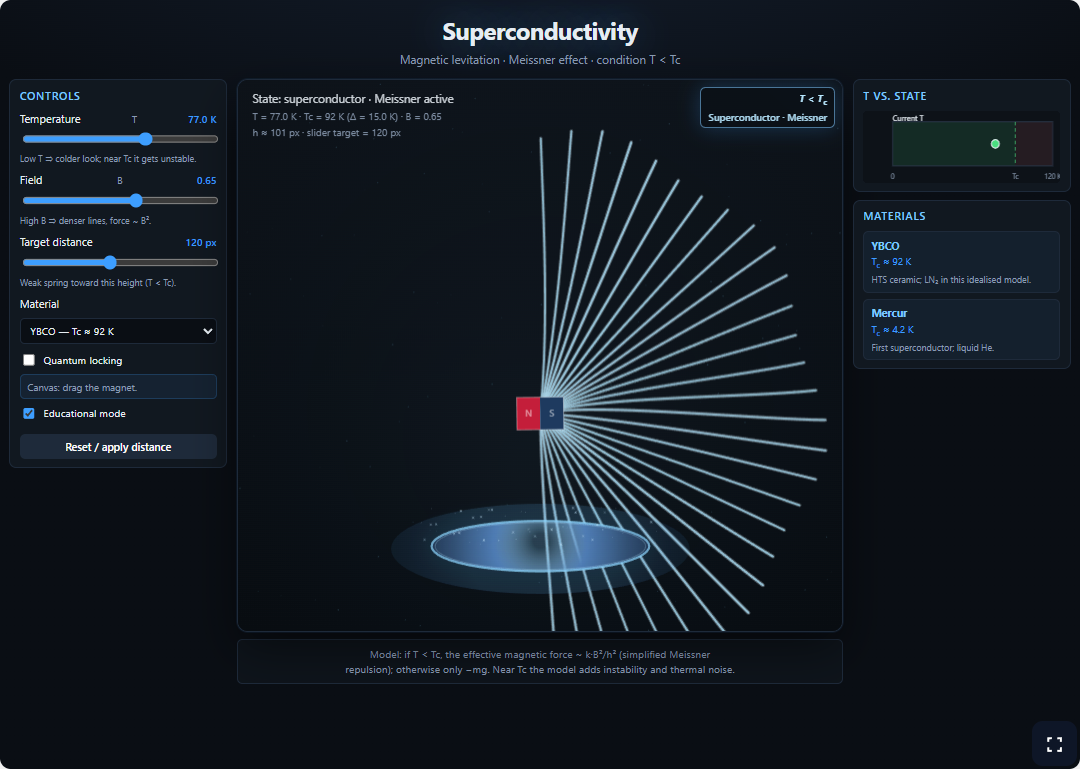
Here you can see electromagnetism directly: magnetic field, levitation and transition to the normal state when temperature exceeds T_c.
Formulas and explanations
Superconductivity condition
Below the critical temperature T_c the material becomes superconducting and magnetic field screening appears.
Magnetic force (educational model)
In the simulator the repulsive effect grows with the square of magnetic field B and decreases as distance h increases.
Vertical balance
Stable levitation occurs when magnetic force balances weight (F_m ≈ mg).
London penetration depth
Describes the scale over which the magnetic field penetrates the superconductor before being screened.
PEM fuel cell
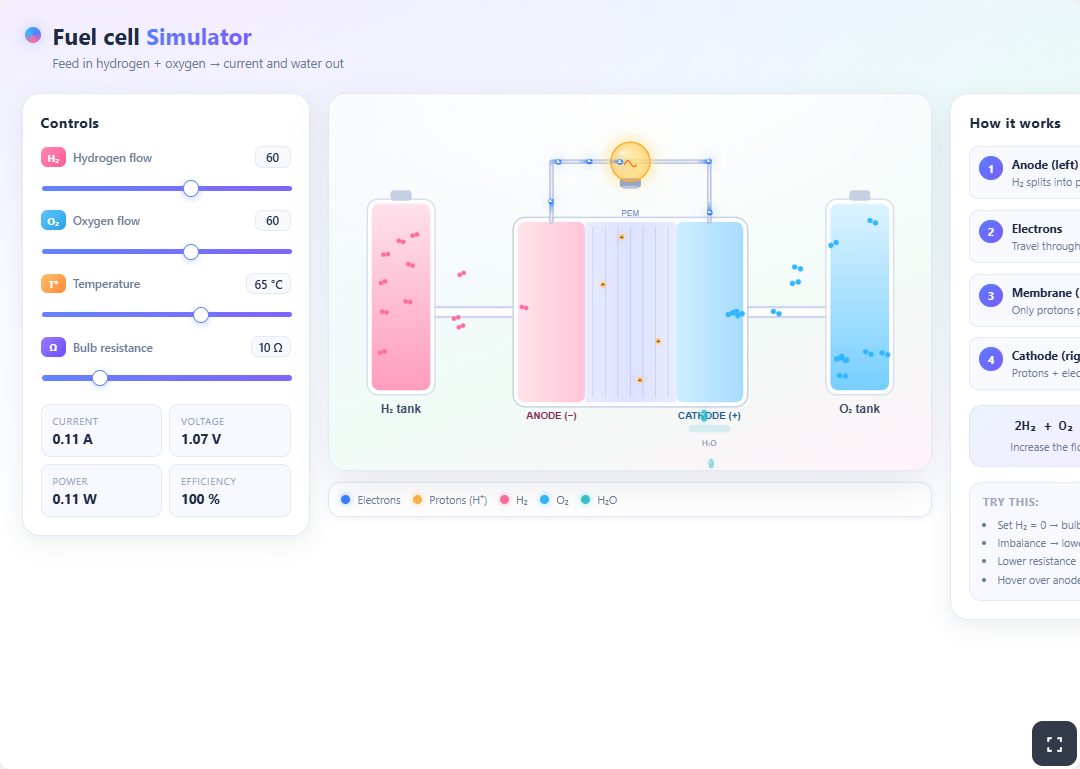
A proton-exchange membrane cell converts the chemical energy of hydrogen and oxygen into electric current: at the anode H₂ is oxidised, electrons travel through the external circuit, and H⁺ crosses the membrane to the cathode where O₂ is reduced and water forms.
Formulas and explanations
Overall reaction (educative model)
Chemical balance of the hydrogen cell: hydrogen and oxygen are consumed, water is produced, and part of the released energy appears as electrical work in the circuit.
Electrical power delivered to the load
Useful power at the terminals is the product of voltage U and current I. In the simulator, higher flows or lower bulb resistance increase I and thus P.
Ohm's law (simple load)
For a resistive load R, current is tied to available voltage. The teaching model also limits current by reactant flow.
Efficiency (working definition)
Efficiency compares electrical power output to power available from the chemical flow of reactants. H₂/O₂ imbalance or internal losses reduce η.