Lasers: from photons to extreme pulses
A laser is a light source with high coherence, very good directionality and, in many applications, a well-controlled wavelength. That combination makes it useful both in laboratory optics and in medicine, telecommunications, metrology or plasma physics.
At Măgurele, the ELI‑NP facility is a European reference for high-power laser experiments, where laser–matter interaction opens discussion of plasma, particle acceleration and extreme conditions in an educationally inspired, real-research setting.
Lasers in brief
A laser produces coherent, directional light that is easy to focus. That makes it ideal for precise measurements, telecommunications, medicine and experiments where energy must be concentrated in a very small region.
When using a laser simulator, pay special attention to wavelength, power, spot diameter and pulse duration — these set intensity, ionisation and the physical regime of interaction with matter.
Short ELI‑NP history
ELI‑NP, developed at Măgurele, is part of the European Extreme Light Infrastructure and was conceived for research at the intersection of high-power lasers and nuclear physics.
For students, ELI‑NP matters because it shows how seemingly theoretical ideas — focusing, peak power or laser–matter interaction — become central in frontier experiments.
Simulator 1: Laser vs matter
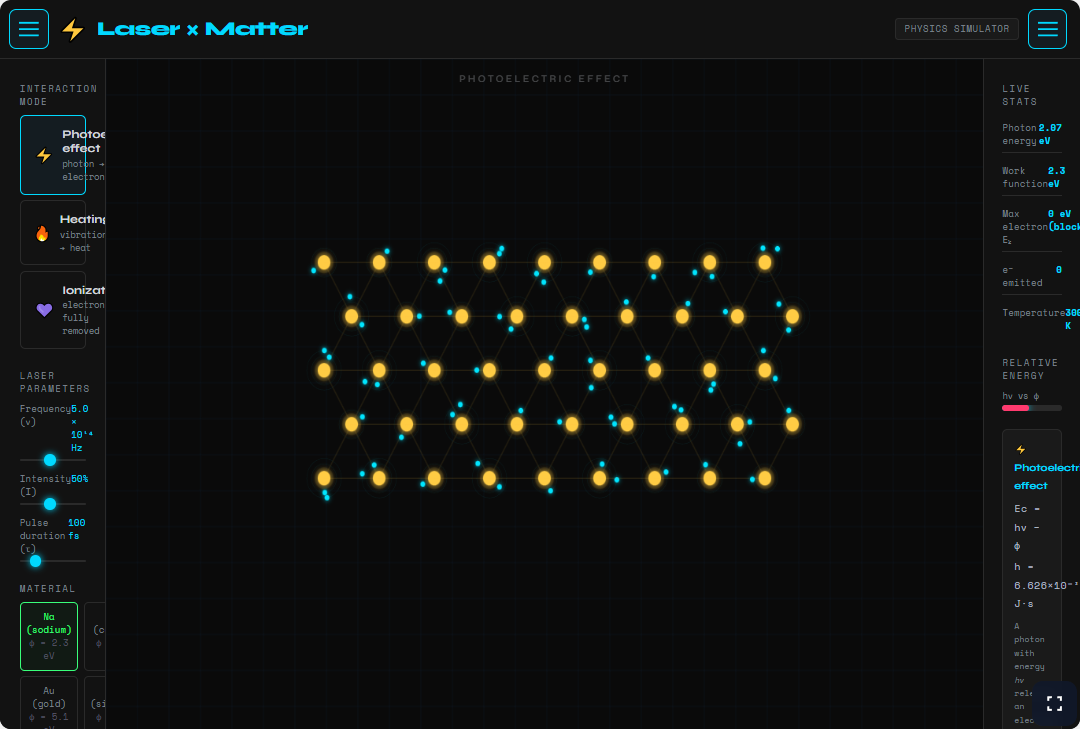
This simulator explores how the beam interacts with the target: by changing interaction mode, material and beam parameters you can observe heating, photoemission or ionisation.
Formulas and explanations
1. Beam intensity
If the spot area shrinks, intensity rises rapidly. In the simulator this immediately affects the material response.
2. Photon energy
Wavelength controls each photon's energy and thus the likelihood of processes such as the photoelectric effect.
3. Radiation pressure
Light carries momentum; at high intensities it can transfer measurable pressure to an illuminated surface.
What to notice in the simulator
- a smaller spot produces stronger effects for the same total power
- materials respond differently to heating and ionisation
- interaction modes help compare thermal effects with photoelectric ones
Simulator 2: ELI‑NP Photon Sniper
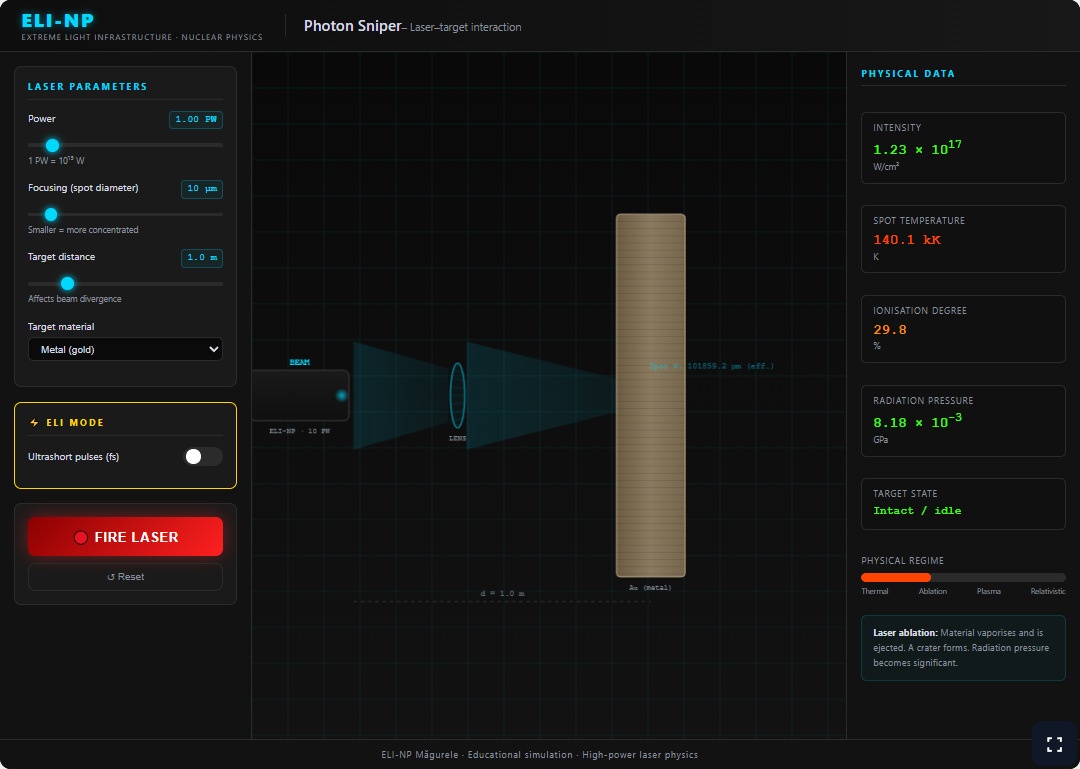
The second simulator is inspired by ELI‑NP and emphasises ultra-short pulses, tight focusing and peak intensity achieved in high-power laser experiments.
Formulas and explanations
1. Peak pulse power
When pulse energy is compressed into an extremely short duration, instantaneous power becomes very large.
2. Peak intensity
High power combined with good focusing leads to extreme regimes where plasma and ablation appear.
3. Gaussian beam divergence
A very tightly focused beam usually diverges more after the focal region.
4. Rayleigh range
This distance indicates the region around the focus where the beam stays relatively collimated.
What to notice in the simulator
- ELI‑NP is linked to extreme laser research at Măgurele
- pulse duration directly affects peak power
- focusing and spot size control the physical regime you observe
Simulator 3: Laser wakefield accelerator
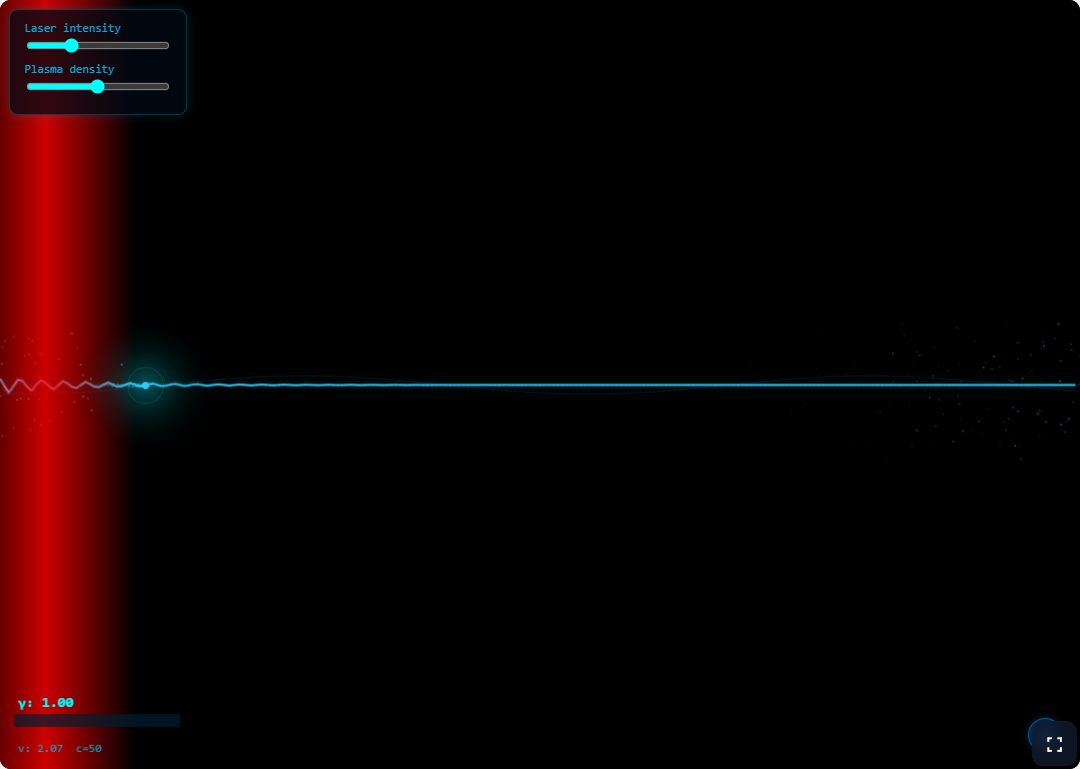
The third simulator sketches LWFA (Laser WakeField Acceleration): the laser pulse drives a plasma wave, and an electron can stay in the accelerating phase and gain energy over short distances.
Formulas and explanations
1. Plasma wave (simplified model)
The wakefield is represented here by a sinusoidal profile: amplitude A grows with laser intensity, and spatial frequency depends on plasma density.
2. Beam intensity
For the same power P, focusing to a smaller A_spot increases intensity and stronger acceleration fields in the plasma.
3. Electron Lorentz factor
As electron speed v approaches c, γ grows rapidly, highlighting the relativistic regime in the accelerator.
4. Relativistic energy
This links γ directly to electron energy. In the simulation energy rises when the electron stays in phase with the plasma wave.
What to notice in the simulator
- higher intensity increases wakefield amplitude and electron acceleration
- plasma density changes the wave period and capture conditions
- if the electron falls out of the accelerating phase, energy gain drops