Mathematics — Functions and 4D visualizer
Mathematics supplies the precise language used to describe physical phenomena. Here we explore graphing functions and visualizing geometric objects in four-dimensional space — useful in analysis and theoretical physics alike.
Function plots reveal relationships between quantities, while the 4D visualizer shows how geometric objects extend into higher dimensions.
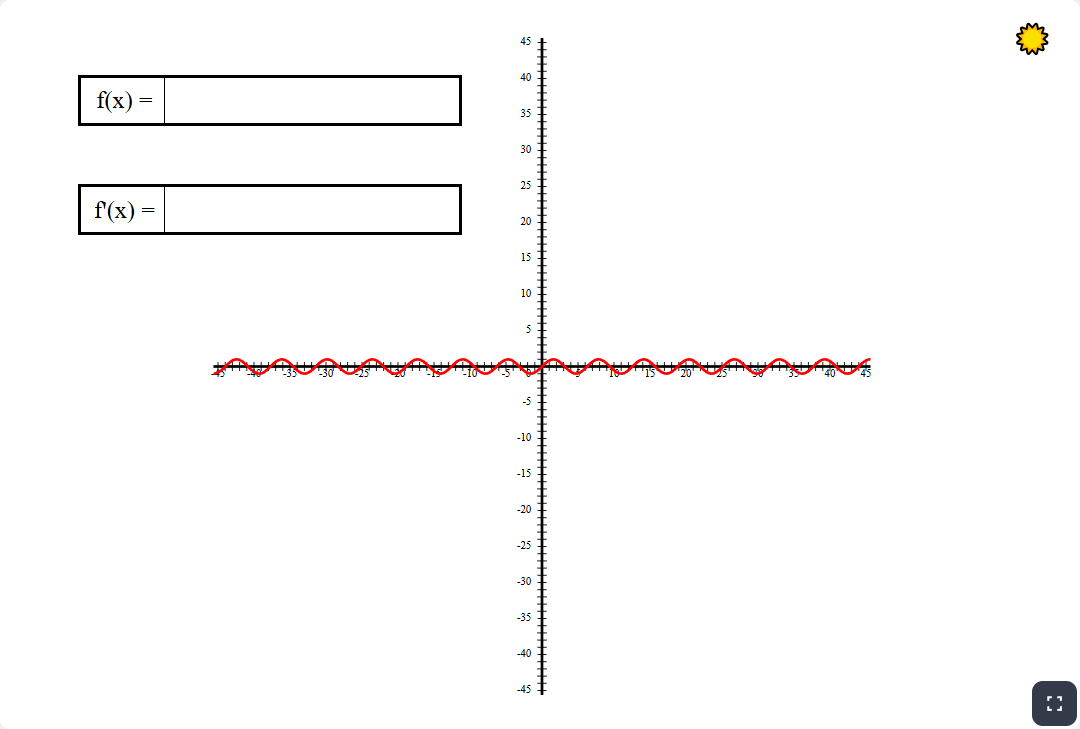
Function graphs
Graphs highlight domains, codomains, zeros, extrema and limiting behaviour. Elementary functions — polynomial, trigonometric, exponential and logarithmic — are foundational in physics modelling.
4D visualizer
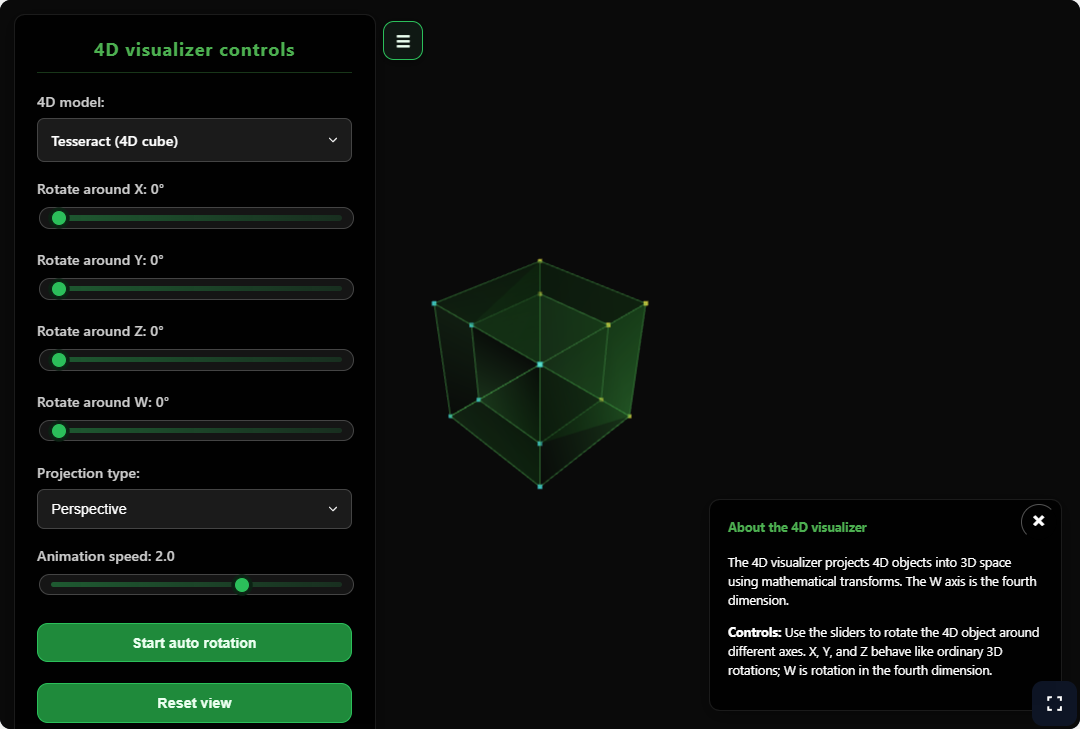
Four-dimensional space extends ideas from 3D geometry. We cannot "see" the fourth dimension directly, but we can project 4D objects (such as the hypercube) into 3D or 2D, just as we project a cube onto a sheet. These ideas appear in relativity (spacetime) and advanced mathematics.
Ideas from 4D geometry:
1. Hypercube (tesseract):
The 4D analogue of a cube; it has 16 vertices, 32 edges, 24 square faces and 8 cubic cells.
2. Projection 4D → 3D:
You obtain a 3D 'shadow' of a 4D object, analogous to projecting a cube onto a plane yielding a hexagon or square.
3. Rotation in 4D:
In 4D there are six planes of rotation (pairs of axes). The visualizer can rotate objects in those planes.
4. Spacetime (Minkowski):
In relativity the fourth dimension is time; the Minkowski metric describes distances in spacetime.